
Key facts: Soot Removal
- Soot is fine carbon particulate formed by incomplete combustion; most of it is small enough to inhale deeply [1][2].
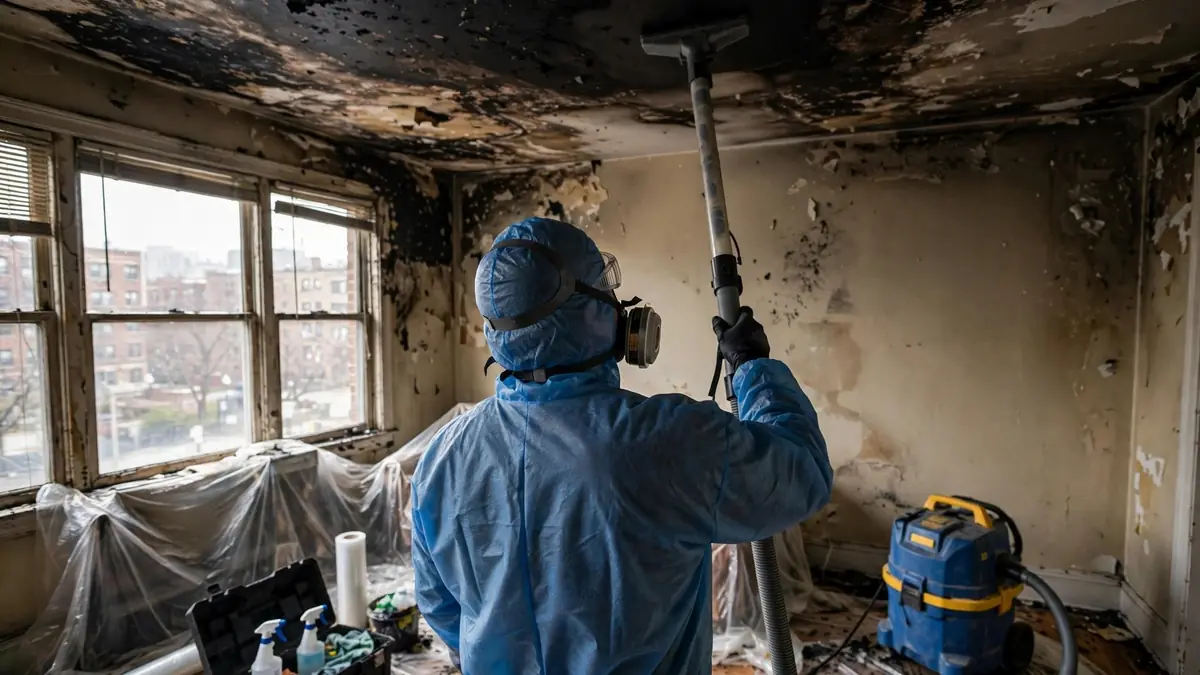
- Dry soot should be removed with HEPA vacuuming and dry chemical sponges before any wet cleaning, or it smears into the surface.
- The IICRC S700 standard addresses source removal of fire residues from structures, HVAC systems and contents [3].
- Illinois insurance guidance says to photograph damage before cleaning and to keep receipts for every repair [4].
- Painted surfaces in Chicago homes built before 1978 may contain lead, so sanding or scraping sooty paint requires lead-safe work practices [5].
How it works
What soot is and why it clings so stubbornly
Soot forms when something burns without enough oxygen to finish the job. Instead of turning completely into carbon dioxide and water, part of the fuel leaves as tiny carbon particles coated with oils, tars and acids from whatever burned [1]. The particles are so small that they stay airborne for a long time, follow air currents through the house and settle on any surface cooler than the air around them.
Because the particles are so fine, they work into the texture of a surface. Flat paint, plaster, raw brick and unfinished wood have microscopic pores, and soot settles into them. Pressing on the soot, rubbing it with a damp cloth or brushing it with a broom pushes it deeper and spreads the oily coating across a larger area. What was a loose layer that could have been vacuumed off becomes a stain that needs sealing or replacement.
Soot also has chemistry. Residue from burning plastics, rubber and many household synthetics is acidic, and over time it can pit metal, etch glass and discolor grout and stone. That is why speed matters: the earlier loose soot is captured, the less of it bonds to surfaces or attacks finishes.
Signs
Where soot hides after the visible mess is gone
Soot settles in predictable places. Checking them gives a truer picture of how far it went.
Tops of door frames and trim
Horizontal ledges collect the heaviest layer and are easy to miss when walls are cleaned.
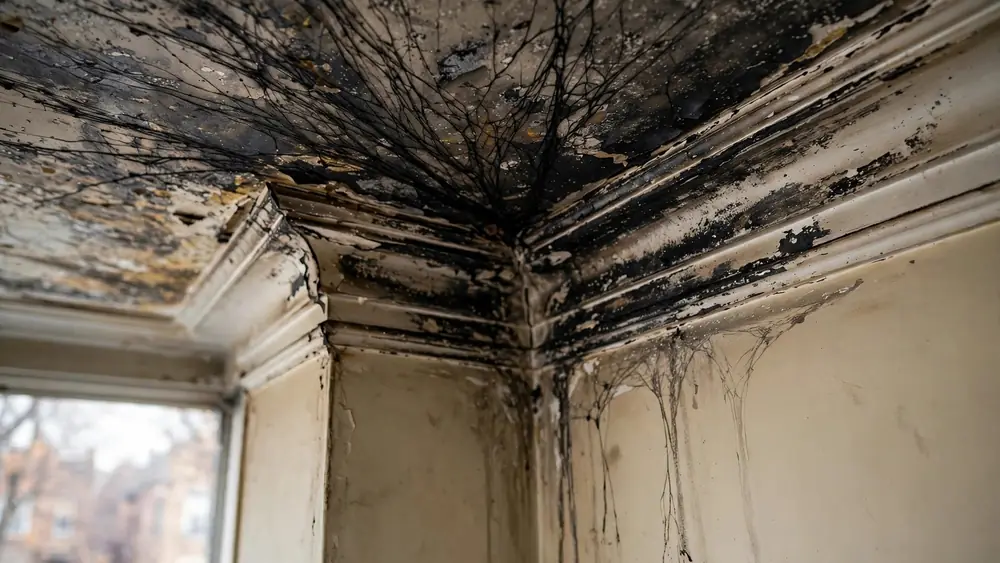
Cobweb-like black strands
Soot clings to old spider webs and dust strands in ceiling corners, forming dark threads that look like cobwebs.
Inside light fixtures
Glass globes, fixture bowls and ceiling fans hold a surprising amount of residue.
Behind and under appliances
Refrigerator coils, the back of the stove and the space under the dishwasher collect soot that later recirculates.
Window tracks and storm windows
Double-hung windows and storm sashes in older Chicago homes trap soot in their channels and sills.
Radiator fins and baseboard heaters
Hot-water and steam radiators common in vintage buildings have fins and crevices that hold residue and bake odor into it when the heat comes on.
Return air ducts
Black streaking around return grilles means soot entered the duct system.
Basement joists and rim boards
After a basement fire or furnace problem, the exposed joists overhead collect a thick layer that can be overlooked.
Why it happens
Common sources of heavy soot in Chicago homes
Most heavy soot comes from a fire that burned slowly or ran out of air: a smoldering couch, a kitchen fire behind a closed door, or a fire in a basement storage room. Plastics, foam cushions and synthetic carpeting produce particularly dark and oily soot when they burn.
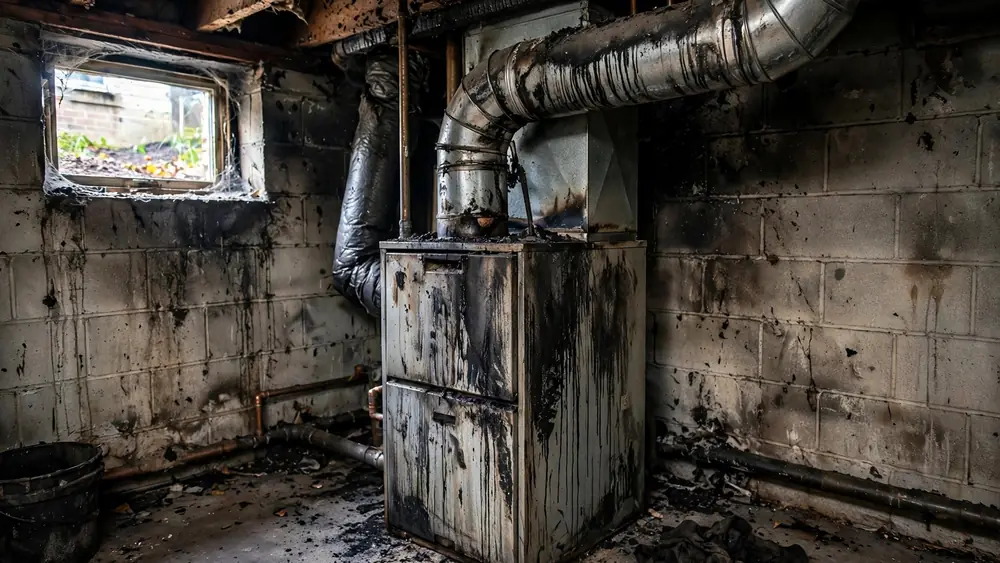
A second common source is a furnace puff-back. An oil-fired burner that fails to ignite cleanly can build up fuel vapor and then ignite it all at once, blowing soot out through the heat exchanger and the duct system into every room. Although most Chicago homes heat with natural gas, some older homes and buildings still have oil equipment, and gas appliances that are badly out of adjustment can also produce soot. A puff-back covers a whole house in a thin oily film without any visible flames.
Candles, oil lamps and fireplaces that draft poorly can leave smaller amounts of soot over time, often showing up as dark lines along carpet edges or ceiling outlines that trace the framing behind the drywall. These are maintenance problems rather than fire damage, but the cleaning principles are the same.
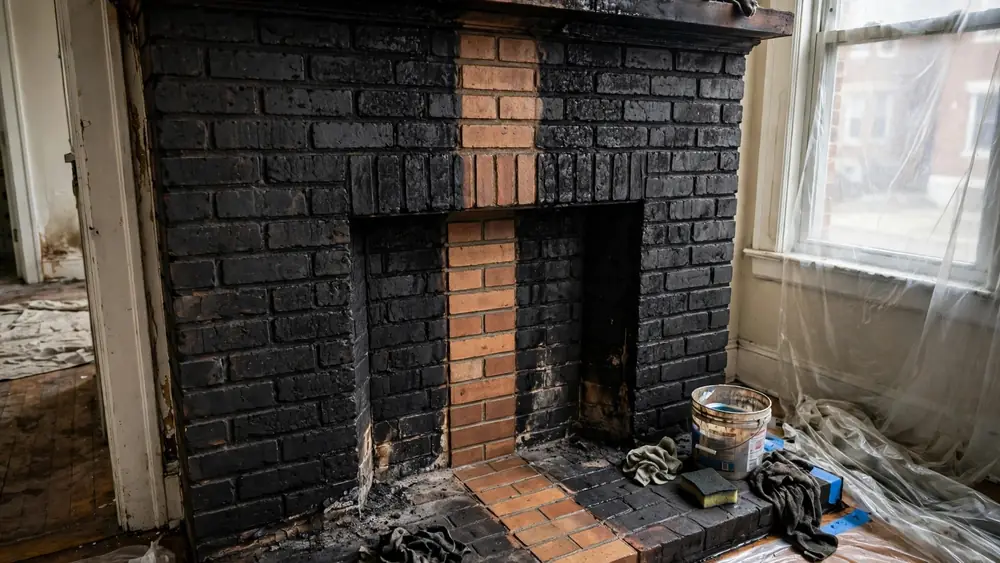
Fireplaces deserve a word in a city full of vintage homes. A chimney that has not been inspected in years can have cracked flue liners, blockages or creosote buildup, and a chimney fire can deposit soot in the rooms nearby. After any fireplace incident, the chimney should be inspected before it is used again.
The removal
Soot removal from start to finish
- 1
Protect the clean areas
Plastic sheeting and zipper doors separate sooty rooms from clean ones, and floors along work paths are covered.
- 2
Set up air filtration
HEPA air scrubbers run throughout the job to capture particles knocked loose during cleaning.
- 3
HEPA vacuum everything loose
Ceilings, walls, ledges, fixtures and floors are vacuumed with HEPA-filtered equipment using soft brush attachments that do not press the soot in.
- 4
Dry sponge the walls and ceilings
Vulcanized rubber dry chemical sponges lift the remaining film. They are turned and replaced as they load up.
- 5
Wet clean by residue type
Degreasers for oily soot, mild alkaline cleaners for light residue, worked from the ceiling down with frequent rinse changes.
- 6
Treat masonry and stone
Brick, limestone and stone fireplace surrounds are cleaned with methods chosen for the material; aggressive blasting is avoided on soft historic brick.
- 7
Clean the ducts and air handler
Registers, returns, ducts and the air handler are cleaned so soot does not blow back into finished rooms [3][6].
- 8
Seal and finish
Surfaces that remain stained after cleaning are sealed with a primer that blocks stains and odor before repainting.
Methods
Soot removal methods compared
Each method has a place. Using the wrong one first is how soot turns into a permanent stain.
| Method | Best for | Limits |
|---|---|---|
| HEPA vacuuming | Loose soot on every surface, first pass | Does not remove bonded film |
| Dry chemical sponge | Painted walls and ceilings, wallpaper, lampshades | Not for oily soot; loads up quickly |
| Alkaline or degreasing wet cleaning | Oily soot, sealed surfaces, cabinets, trim | Can damage water-sensitive finishes; test first |
| Abrasive blasting (soda, dry ice) | Framing, joists, heavily charred structural wood | Needs containment; not for finished surfaces |
| Masonry-safe cleaners | Brick, limestone, fireplace surrounds | Historic brick is soft; harsh methods erode it |
| Sealing primer | Surfaces still stained after cleaning | Seals what remains; does not replace cleaning |
What you can do yourself
Homeowner steps that help instead of hurt
Only after the fire department has cleared the building, and with gloves and an N95 or better respirator.
- Photograph firstCapture the soot pattern on every surface before anything is touched. It shows how far the residue traveled [4].
- Close the HVAC systemLeave the furnace and air conditioning off and cover returns with plastic if soot is still airborne.
- Lift small items off sooty surfacesRemove items carefully without wiping them, and put them in clean bins away from the sooty area.
- Avoid household vacuumsStandard vacuums blow the finest soot back into the air through the exhaust. HEPA filtration is needed.
- Keep pets and children outSoot particles are small enough to reach deep into the lungs [2].
Local specifics
Soot on Chicago brick, limestone and plaster
Chicago's housing gives soot removal a particular character. Bungalows are mostly brick [7], greystones carry Indiana limestone fronts [8], and many vintage interiors still have original plaster walls, wood trim and built-in cabinetry. These materials can be cleaned, but each needs care. Old common brick is softer than modern brick and can be eroded by aggressive pressure washing or blasting. Limestone reacts to acids and can be stained by the wrong cleaner. Plaster tolerates careful wet cleaning but can absorb water through cracks.
Original woodwork, often oak or pine with old shellac or varnish finishes, may not survive strong solvents. Testing a hidden spot first is standard practice. Where the finish has failed, refinishing is often a better outcome than trying to scrub soot out of the grain.
Lead paint is the other local issue. Homes built before 1978, which covers most of the city's bungalow belt and two-flat stock, may have lead in older layers of paint. Scraping, sanding or demolishing sooty painted surfaces in those homes falls under EPA's lead renovation rule, which requires certified renovators and lead-safe work practices [5]. A contractor should raise this before work starts.
Chicago's steam and hot-water radiators also need attention. Soot that settles on radiators bakes onto them and keeps releasing odor every time the heat comes on, so they are cleaned along with the walls.
Diagnosis
Reading the soot before picking a method
Before choosing a cleaner, a contractor looks at the soot itself. Powdery, gray-black soot that wipes off a fingertip easily is usually from a hotter, faster fire and is mostly dry. Black soot that leaves a greasy smear points to plastics, foam or petroleum products, or to a puff-back. A thin yellow-brown film with a strong smell, especially near the kitchen, is protein residue rather than soot, and needs different handling.
They also look at the pattern. Soot concentrated near the ceiling and fading downward tells you the hot smoke layer hung there. Streaks around outlets and along the ceiling framing show air movement through the walls. A uniform film throughout the house with no burned area at all points to the heating system as the source.
Those observations become part of the written scope, which helps your insurer understand why certain rooms need more work than others.
Quick reference
Soot patterns and what they usually point to
| What you see | Likely cause | What it means for the cleanup |
|---|---|---|
| Dark band along every ceiling | Hot smoke layer spread across the floor | All ceilings on that level need cleaning, not just the fire room |
| Black lines tracing ceiling joists | Temperature differences over framing | Residue bonded where surfaces were cooler; dry sponging plus sealing often needed |
| Even oily film in every room, no burn | Furnace puff-back | Full HVAC cleaning plus whole-house cleaning |
| Heavy soot near one closet or room | Smoldering fire in stored items | Source removal, then cleaning outward |
| Soot around outlets and baseboards | Air leakage through wall cavities | Wall cavities and insulation may hold soot |
| Soot on the fireplace face and mantel | Poor draft or chimney problem | Chimney inspection before next use |
Puff-backs
Furnace puff-backs: soot without a fire
A puff-back happens when an oil burner misfires and the unburned fuel vapor ignites inside the combustion chamber. The small explosion pushes soot through the heat exchanger and, if the blower is running, through the ducts into every room. The result is a fine, oily black film on walls, ceilings, furniture and clothes, often across the entire house.
The first call after a puff-back is to have the heating equipment shut down and repaired by a qualified heating technician. Then the soot cleanup follows the same order as after a fire: filtration, HEPA vacuuming, dry and then wet cleaning, contents cleaning and duct cleaning. Many homeowner policies treat puff-back damage as a covered event, so the same documentation steps apply [4].
Health
Why soot is a health concern, not just a stain
Soot is a form of fine particulate matter. EPA notes that particles of this size can get deep into the lungs and some may even enter the bloodstream, with effects ranging from irritation and coughing to aggravated asthma and heart problems in sensitive people [2]. Children, older adults and people with heart or lung conditions are most at risk.
During cleanup, soot that is disturbed becomes airborne again. That is why professionals run HEPA air scrubbers, wear respirators and contain the work area. If you are staying in part of the house during the work, ask the contractor how they will keep the occupied rooms separated.
Do it yourself?
Soot jobs that are and are not a homeowner task
Small candle or lamp soot
A light line above a candle on a glossy wall can often be lifted with a dry sponge.
Washable hard items
Dishes, glass and metal items can be cleaned once you know the soot is dry and light.
Whole rooms or ceilings
Needs HEPA equipment, containment and the right sequence. Leave it to a crew.
Anything oily or from a puff-back
Oily soot spreads with every wipe and usually reaches the ducts. Professional cleaning is the safe route.
The visit
What to expect from a soot removal crew
Expect the crew to spend the first part of the visit setting up rather than cleaning: hanging plastic, laying floor protection, placing air scrubbers and testing surfaces. That preparation is what keeps soot from spreading into the clean parts of the home.
Ask how they will handle the ceilings, which are the hardest part, and what they plan for the radiators, the fireplace and the HVAC system. Ask how they will document their work for your insurer, and whether they follow IICRC guidance [3]. In buildings with lead paint risk, ask to see their EPA lead-safe certification [5].
If walls, ceilings or framing have to be opened or replaced, that repair work in Chicago may need a building permit [9]. The contractor should say when cleaning ends and construction starts.
Prevention
Keeping soot from coming back
Annual service on the furnace or boiler catches burner problems before they produce soot or a puff-back. Chimneys should be inspected regularly, and wood-burning fireplaces need a working damper and a clean flue.
Changing furnace filters on schedule reduces the amount of residue that recirculates after any event. Smoke alarms on every level, including the basement, are still the best way to catch a smoldering fire before it soots up an entire house [10].
Clean or replace
When sooty materials should come out instead
Soot removal works when the material is sound. Charred drywall, insulation that has soaked up soot, acoustic ceiling tiles and carpet pad that sat under heavy soot are usually removed, because cleaning cannot reach the residue inside them. Framing that is charred on the surface can often be cleaned and sealed if it is structurally sound, but deeply charred members may need assessment by a qualified professional.
Upholstered furniture and mattresses that sat in heavy soot are judged on their condition and the strength of the remaining odor. Hard furniture usually cleans well. Keep any items you decide not to keep until the adjuster has seen them [4].
Contents
Soot on furniture, electronics and keepsakes
Belongings collect soot the same way walls do, and the same rule applies: lift the loose particles before anything wet touches them. Upholstery is vacuumed with HEPA equipment and a soft brush before any cleaning solution is tested. Lampshades, books and fabric items often respond well to dry sponging alone.
Electronics are a special case. Fine soot can enter vents and settle on circuit boards, where acidic residue may corrode contacts over weeks or months. Devices that seem to work after a fire can fail later. Unplug them, do not run them, and let a specialist decide whether they can be cleaned. Keep them for your adjuster either way, since Illinois guidance asks owners not to discard items that may be a total loss until the insurer has examined them [4].
Photographs, artwork and documents should be handled by the edges and kept dry. Soot on a photograph's surface can often be removed by a conservator, but rubbing it at home usually scratches the image.
Timeline
How long a soot cleanup usually takes
A single room with light, dry soot can often be finished in a day or two once equipment is set up. A whole floor after a smoldering fire, with ceilings, radiators, cabinets and contents, takes longer, and a full-house puff-back often takes the longest because every room and the ductwork are affected at once.
Repairs come after cleaning. If drywall, insulation or flooring has to be replaced, the rebuild adds its own time, plus any permit review for work that requires one. A written scope should spell out the order of work so you know when each room will be usable again.
FAQ
Soot removal questions
Can I wash soot off the walls with soap and water?
Not as a first step. Water spreads dry soot into the paint and leaves a permanent stain. Soot is vacuumed and dry-sponged first; wet cleaning comes after, with a cleaner suited to the residue.
Is soot dangerous to breathe?
Yes. Soot is fine particulate matter that can reach deep into the lungs and aggravate asthma and heart conditions. Wear an N95 or better respirator in sooty areas and keep vulnerable people out.
What is a furnace puff-back?
A puff-back is a misfire in an oil burner that blows soot through the heat exchanger and ducts into the house. It can coat a whole home in oily black film without any visible fire.
Can soot be removed from brick and stone?
Usually, yes, with methods chosen for the material. Old Chicago common brick is soft and limestone reacts to acids, so harsh pressure washing or acidic cleaners can do more harm than the soot.
Why are there black lines on my ceiling in a grid pattern?
Grid-like black lines usually trace the ceiling joists. The surface over the framing is a slightly different temperature, so soot settles there more heavily. Cleaning plus a stain-blocking primer is common.
Does soot removal include the ductwork?
Soot removal should include the ductwork if soot reached the HVAC system. Cleaning rooms without cleaning the ducts often lets soot blow back once the heat or air conditioning runs.
Will paint cover soot stains?
Regular paint over soot usually bleeds through. Surfaces are cleaned first and then sealed with a stain- and odor-blocking primer before the finish coat.
Sources and citations
- [1]Wikipedia — Soot
- [2]U.S. EPA — Particulate matter basics
- [3]IICRC — ANSI/IICRC S700 Standard for Fire and Smoke Damage Restoration
- [4]Illinois Department of Insurance — What to do after an insured homeowners loss
- [5]U.S. EPA — Lead Renovation, Repair and Painting Program
- [6]U.S. EPA — Should you have the air ducts in your home cleaned?
- [7]Wikipedia — Chicago bungalow
- [8]Wikipedia — Greystone (architecture)
- [9]City of Chicago — Department of Buildings permits
- [10]NFPA — Smoke alarms