
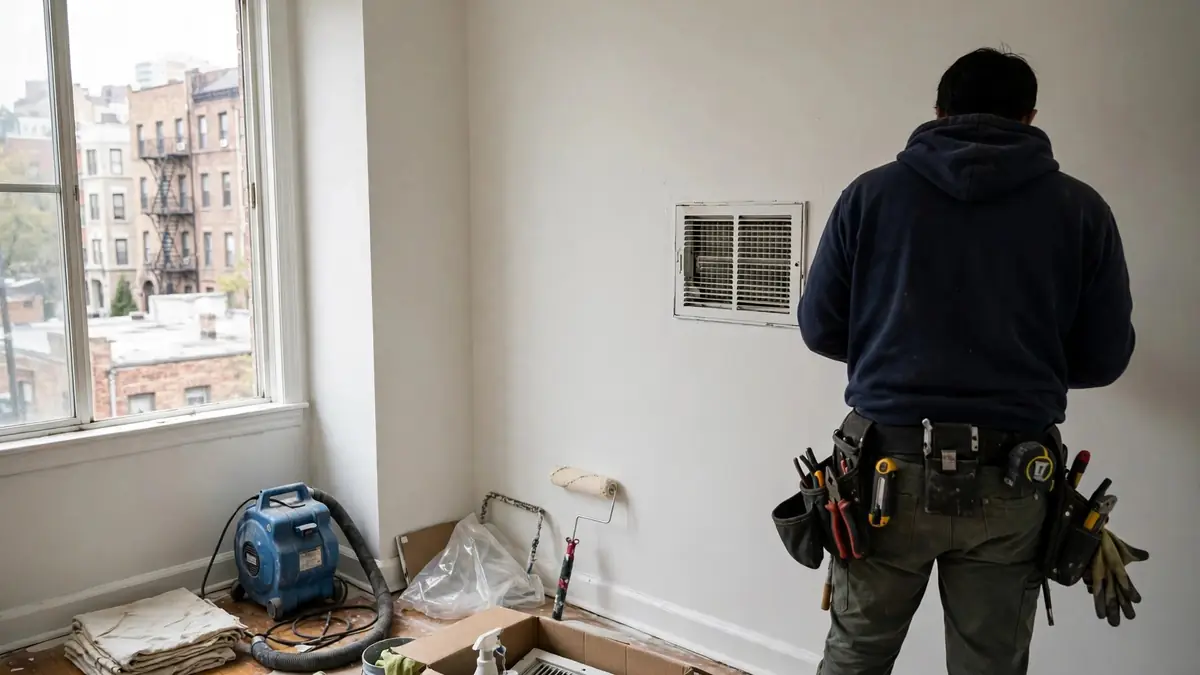
Key facts: Smoke odor that won't go away
- Persistent smoke odor comes from residue in porous materials, wall cavities, insulation, ducts or belongings, not from the air itself.
- The IICRC S700 standard treats odor management as one part of a process that includes source removal and HVAC cleaning [1].
- EPA says ozone at levels safe for people does little to remove odors and should only be used at high levels in unoccupied spaces [2].
- EPA advises fixing the cause before cleaning ducts and does not routinely recommend sealants or biocides in ducts [3].
- Humidity and heat make residue release more odor, which is why smells often return on warm, damp days.
Short answer
Why a cleaned house can still smell of smoke
Smoke odor comes from compounds that evaporate slowly out of residue. If walls were wiped but the residue inside the insulation, the ducts, the furniture foam or the subfloor was never removed, those materials keep releasing smell. Air fresheners, open windows and household sprays cover it for a while, then it comes back.
The fix is to find each source, clean or remove it, seal what is left, and only then treat the remaining odor. That is the order the industry's fire restoration standard follows [1], and it is why one-step odor treatments rarely work on their own.
Find the source
Where lingering smoke smell usually hides
| When or where it smells | Likely hiding place | How to check |
|---|---|---|
| When the furnace or AC runs | Ducts, blower, coil, filter | Look into a return grille with a flashlight; check the filter |
| Near outlets and switch plates | Wall cavities and insulation | Remove a cover plate and smell the opening |
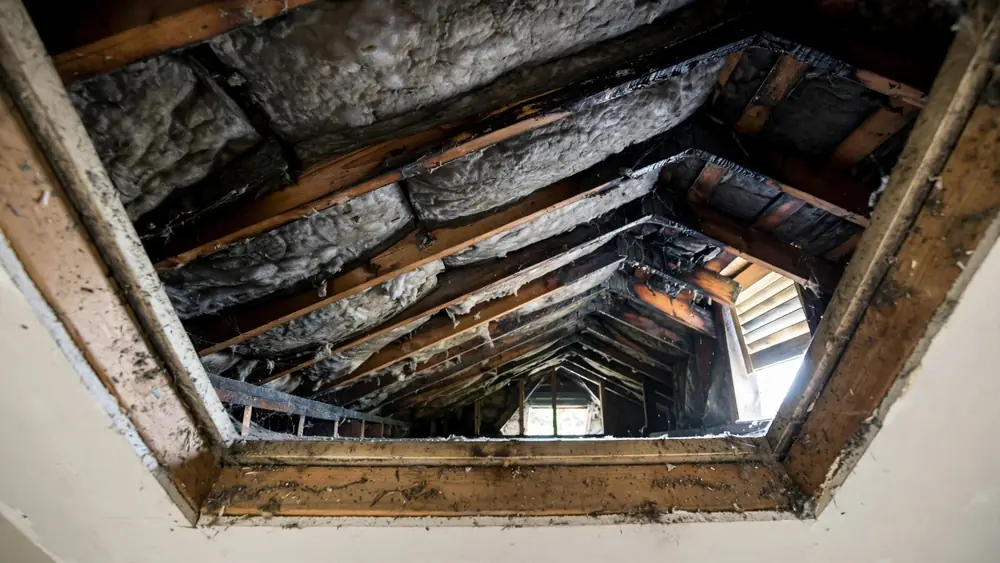
| Upstairs in a bungalow or two-flat | Attic insulation, knee-wall spaces | Open the attic hatch or knee-wall panels |
| When radiators heat up | Residue baked onto radiator fins | Smell at the radiator when it first warms |
| In closets and drawers | Clothing and the closet walls | Compare a closet's smell to the room |
| Near the sofa or bed | Foam in cushions and mattresses | Press on cushions and smell the air released |
| Kitchen, greasy smell | Protein residue in cabinets and hood | Wipe the inside of an upper cabinet with a white cloth |
| Stairwell in a multi-unit building | Shared spaces not yet cleaned | Ask the owner or association what was cleaned |
Safe checks
Checks you can make yourself
- Run the system and sniff the registersIf odor rises when the blower starts, the HVAC system is a source.
- Swap the furnace filterA dark filter is evidence; a new one helps, but will not fix residue in the ducts.
- Check cover platesRemove an outlet cover on an outside or shared wall and smell the opening.
- Look in the atticGray or black insulation means smoke reached it.
- Do the cloth testWipe hidden surfaces like cabinet interiors or door tops with a white cloth; a gray or yellow smear means residue remains.
- Note the weatherOdor that spikes on humid days points to porous materials still holding residue.
What works
What actually removes smoke odor
Source removal comes first. Smoke-soaked insulation, carpet pad and foam that cannot be cleaned are removed. Wall cavities with residue are opened, cleaned and sealed. Ducts, the blower and the coil are cleaned so the system stops redistributing residue [3]. Every surface is cleaned with methods suited to the type of residue (see cleaning heavy carbon deposits), including cabinet interiors and the tops of door frames.
Sealing locks in what cleaning cannot reach. Framing and drywall that remain stained are coated with an odor-blocking primer before insulation and finishes go back. This is standard practice and works well when it follows cleaning.
Odor treatment finishes the job. Thermal fogging, hydroxyl generators, carbon filtration and, in an empty home, controlled ozone can break down remaining odor molecules. Each has trade-offs; EPA notes that ozone at safe levels does little for odors and at high levels must only be used in unoccupied spaces, and that it can damage rubber, fabrics and artwork [2].
What does not
Odor fixes that usually disappoint
Air fresheners, scented candles and plug-ins only mask smoke. Bowls of vinegar, coffee or baking soda can absorb a small amount of odor from the air but cannot reach residue in walls or ducts. Painting over smoke-stained walls with regular paint traps the residue, and it often bleeds through within weeks.
Renting an ozone machine and running it yourself is risky. EPA warns that ozone irritates the lungs, is not reliable for odor removal at safe levels, and can produce irritating byproducts when it reacts with household materials [2]. If ozone is used at all, it should be done by a contractor in an empty, controlled space, after cleaning.
Diagnosis
How a contractor tracks down a stubborn odor
- 1
Interview
When is the smell strongest? Which rooms? Does it change with the heat, humidity or time of day?
- 2
Walk-through
Every room, closet, the basement, attic, garage and, in multi-unit buildings, the shared spaces.
- 3
System check
Registers, returns, filter, blower and coil are inspected for residue.
- 4
Cavity inspection
Small inspection openings or outlet removals show whether insulation is contaminated.
- 5
Targeted plan
Each source gets a specific action: remove, clean, seal or treat.
- 6
Verification
The house is closed up and the system run before the job is called finished.
Chicago homes
Why older Chicago buildings hold smoke smell
Chicago's older homes have more places for odor to hide than a modern house. Plaster-and-lath walls, balloon-framed cavities that run from basement to attic, bungalow knee walls and half-story attics, steam radiators and shared stairwells all hold or carry residue. In two-flats and courtyard buildings, odor from a neighbor's fire can keep coming back until the shared spaces are cleaned.
The seasons matter too. A long heating season keeps windows shut and dries materials, while humid summers reactivate residue. A home that seemed fine in winter can smell again in July, which is a signal that a source was missed, not that the cleanup failed entirely.
FAQ
Lingering smoke odor questions
How long does smoke smell last after a fire?
Without proper cleaning, it can last for months or years. With source removal, cleaning, sealing and treatment, most homes are odor-free within days to a few weeks.
Why does the smoke smell come back when it rains?
Humidity makes residue in porous materials release odor faster. If the smell returns in damp weather, residue is still in drywall, insulation, wood or fabric.
Will repainting get rid of smoke smell?
Only if the walls are cleaned first and then sealed with an odor-blocking primer. Regular paint over residue tends to let the smell and stains come through.
Is it safe to live with a lingering smoke smell?
The smell signals residue that may include irritants and fine particles. People with asthma or heart conditions can be more sensitive. Removing the source is the safest course.
Can I get smoke smell out of clothes?
Usually, with laundering or dry cleaning designed for smoke residue, sometimes over several cycles. Ask before washing everything at home, since some residues set in hot water.
Does insurance cover odor removal after a fire?
Odor removal is often part of a covered fire loss, but policies differ. If odor remains after cleaning, tell your adjuster and ask the contractor to document the sources.