
Key facts: Working with your insurance adjuster
- Illinois guidance says a fire claim is usually split into one part for the building and one for personal property, and may include additional living expenses [1].
- The same guidance says not to throw out damaged furniture or other items of value until the adjuster has seen them [1].
- Illinois law requires public adjusters to be licensed by the Department of Insurance, and consumers can verify a license [1].
- Illinois regulations do not allow an insurer's check to say final payment or release of claim unless policy limits are paid or the claim is disputed [1].
- Consumers can file a complaint with the Illinois Department of Insurance if they cannot resolve a problem with their insurer [2].
Short answer
How a fire claim usually works in Illinois
You report the fire to your insurer, get a claim number and are assigned an adjuster, a trained professional who may be an employee of the insurer or work under contract with it [1]. The adjuster inspects the damage and prepares an estimate. You document the damage, make temporary repairs to prevent further loss and build a list of damaged belongings. Contractors provide scopes of work, and the insurer settles the building, contents and living-expense parts of the claim.
The Illinois Department of Insurance explains that the claim is typically divided into one part for the house and one for personal property, and you may also be entitled to additional living expenses. Payment for the house may be made out to both you and your mortgage holder [1].
Step by step
The fire claim process from first call to settlement
- 1
Report the loss quickly
Call your insurer or agent as soon as possible with as much detail as you can, and give them every number where you can be reached [1].
- 2
Ask about living expenses and advances
Ask whether you have additional living expense coverage and whether an advance is available; keep receipts, because advances are deducted later [1].
- 3
Document everything
Photograph and video every room before cleaning. Keep damaged items for the adjuster to see [1].
- 4
Make temporary repairs
Board up windows, tarp roof openings and start drying, keeping all bills and receipts [1].
- 5
Meet the adjuster
Walk the home together, point out damage, and get the adjuster's name, contact details and a copy of the estimate [1].
- 6
Build the contents inventory
List damaged items room by room with where you bought them, brand, model and age where possible [1].
- 7
Agree on the repair scope
Get your adjuster's agreement before you contract for repairs [1].
- 8
Settle and follow up
If you find more damage or forgot items, contact the adjuster; claims can be reopened for additional items [1].
What the adjuster needs
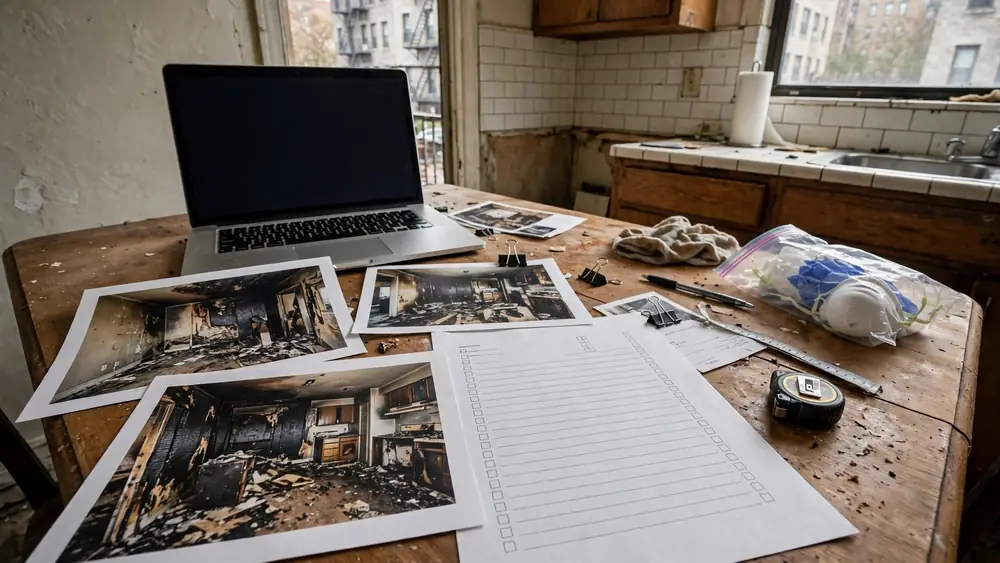
What your adjuster will want from you
- Photos and videoBefore cleaning, of every room, including closets, the basement, attic and garage.
- Damaged items kept for inspectionFurniture, electronics and valuables you plan to discard should be kept until the adjuster sees them [1].
- A contents inventoryItem, room, where bought, brand and model if known, approximate age [1].
- ReceiptsTemporary repairs, lodging, meals, supplies and replacements [1].
- Contractor scopesWritten scopes from the restoration contractor for mitigation, cleaning and repairs.
- The fire reportInsurers often request it; ask the fire department how to obtain a copy.
Contractors
How restoration contractors fit into the claim
Your restoration contractor documents the damage, prepares a scope of work and often communicates with the adjuster about it. Many contractors use the same estimating software insurers use, which can make those conversations easier. Still, you are the policyholder and the one who signs the contract, so read every scope and ask questions.
The Illinois Department of Insurance advises getting your adjuster's agreement before contracting for repairs, being cautious when signing repair contracts, dealing with reputable local contractors and discussing payment terms before signing. It also notes that a reputable contractor is unlikely to ask for full payment up front, and that contracts should tie payments to completed work [1].
Your insurer may suggest contractors it works with. You are generally free to choose your own. Either way, check the contractor's licensing and insurance, and in Chicago ask which repairs will need city permits [3]. Securing the home quickly with board-up and tarping and documenting belongings through a contents pack-out both support the claim.
Know the terms
Insurance terms that come up in fire claims
| Term | What it means |
|---|---|
| Adjuster | The person who assesses the damage for the insurer; may be staff or contracted [1] |
| Public adjuster | A licensed adjuster you can hire to represent you; paid a percentage of the settlement [1] |
| Proof of loss | A sworn statement of your claim that the insurer may ask you to complete [1] |
| Actual cash value | Replacement value minus depreciation [1] |
| Replacement-value coverage | Pays for new items of like kind once you replace them, with actual cash value paid first [1] |
| Additional living expenses | Covers the increase in living expenses while your home is unlivable [1] |
| Mitigation | Steps taken to prevent further damage, such as board-up and drying |
If it stalls
If the claim stalls or you disagree
Start by asking the adjuster to explain their estimate line by line, and give them any documentation they lack. If a contractor finds hidden damage after the estimate, the Illinois guidance says to contact the insurer's representative first and try to resolve the difference [1].
You can hire a public adjuster to represent you on a complex claim. Illinois requires public adjusters to be licensed by the Department of Insurance, and you can contact the Department to verify a license [1]. Understand exactly what services they will provide and how they are compensated before signing.
If you still cannot resolve a problem with your insurer, you can file a complaint with the Illinois Department of Insurance, which can look into it and answer general questions [2].
FAQ
Questions about working with your adjuster
Can I start cleanup before the adjuster visits?
Yes, for steps that prevent further damage, such as board-up, tarping and water extraction. Photograph everything first and keep damaged items. Get the adjuster's agreement before major repairs.
Do I have to use the contractor my insurer recommends?
Generally no. You can choose your own contractor. Make sure your adjuster reviews and agrees to the scope before major work.
What if I forgot to list some damaged items?
Contact your adjuster. Illinois guidance says claims can be reopened for additional items unless policy limits have been paid.
What does a public adjuster do?
A public adjuster represents you, not the insurer, in preparing and negotiating the claim, in exchange for a percentage of the settlement. Illinois requires them to be licensed.
Why is the check made out to me and my mortgage company?
Payments for the building may include the mortgage holder because they have an interest in the property. Contents payments are usually made to you.
Where can I complain about my insurer in Illinois?
The Illinois Department of Insurance accepts complaints and can help with problems you cannot resolve with your insurer.