
Key facts: Duct Cleaning After a Fire
- EPA says duct cleaning is warranted when ducts are clogged with debris or particles are released from the supply registers, and that the cause should be fixed first [1].
- EPA does not recommend sealants or biocides in ducts as routine treatments and notes no biocides are registered for fiberglass duct board or lined ducts [1].
- The IICRC S700 standard includes HVAC and air conveyance systems as a defined part of fire and smoke restoration [2].
- Ready.gov advises against turning utilities back on yourself after a fire until they are confirmed safe [3].
How it works
How smoke gets into a forced-air system
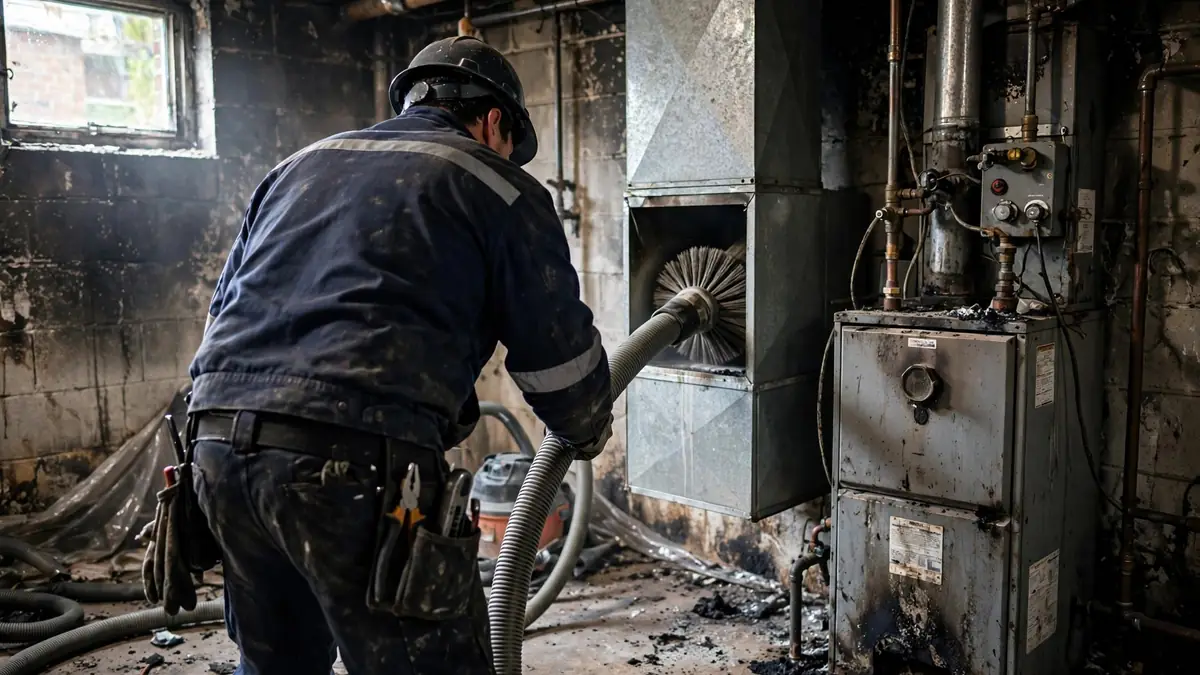
A forced-air furnace or air handler pulls air from the house through return grilles, passes it over a filter, heats or cools it, and pushes it back out through the supply ducts. If the blower was running during the fire, it pulled smoke straight into the return side, through the filter and out into every room it serves. Even with the blower off, smoke drifts into return grilles and settles in the ductwork, especially when the system is close to the fire.
Once inside, soot and residue coat the sheet metal, collect at bends and in the boot behind each register, and load the blower wheel and the cooling coil. When the system starts again, airflow knocks that residue loose and carries it back into the rooms, along with the odor. That is why a home can be spotless for a week and then develop a gray film around the registers after the heat comes on.
The ANSI/IICRC S700 standard lists HVAC and air conveyance systems as their own part of fire and smoke restoration, [2], and IICRC also publishes a separate standard, S590, for assessing HVAC systems after water, fire or mold events. Cleaning the system is part of restoring the home, not an optional extra.
Signs
Signs the ductwork is holding smoke residue
Smell when the blower starts
A burst of smoke odor each time the furnace or air conditioner kicks on points straight to the system.
Dark rings around registers
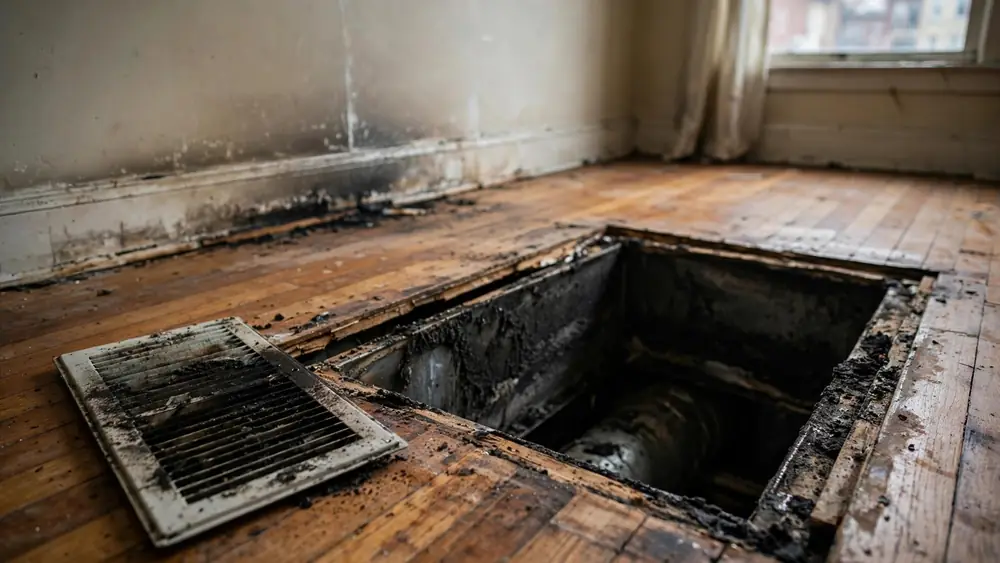
Gray or black staining on the ceiling or wall around supply registers shows residue blowing out of the ducts.
Black filter
A filter that turned gray or black after the fire caught some of the residue, and the rest went past it.
Soot inside return grilles
Look behind a return grille with a flashlight; visible soot on the duct walls means the system needs cleaning.
Film returning on cleaned walls
If a room was cleaned but gets a light film again, the ducts are a likely source.
Dust puffs from vents
Visible particles leaving registers are exactly the condition EPA cites as a reason to clean [1].
The process
How HVAC cleaning after a fire is done
- 1
Shut the system down
The furnace and air conditioner stay off, and the gas and electrical supply to the equipment are confirmed safe before work [3].
- 2
Inspect the system
The contractor checks ducts, the blower, the coil and the plenums, often with a camera, and photographs the residue.
- 3
Protect the rooms
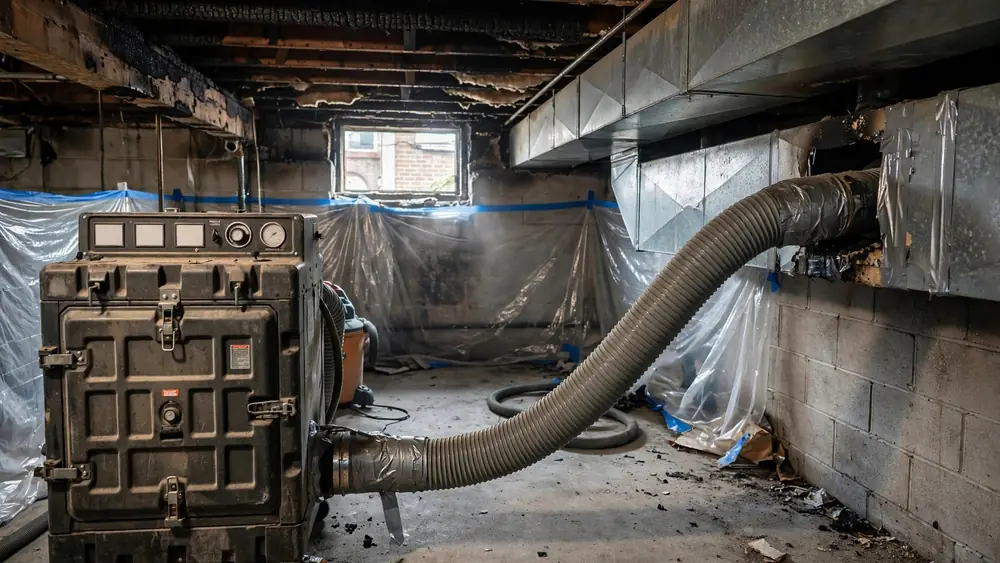
Registers are sealed, and the system is put under negative pressure with a HEPA collection unit so loosened soot is pulled out, not pushed into the house.
- 4
Agitate and collect
Rotating brushes, air whips and compressed air loosen residue inside each run while the collection unit captures it.
- 5
Clean the blower and coil
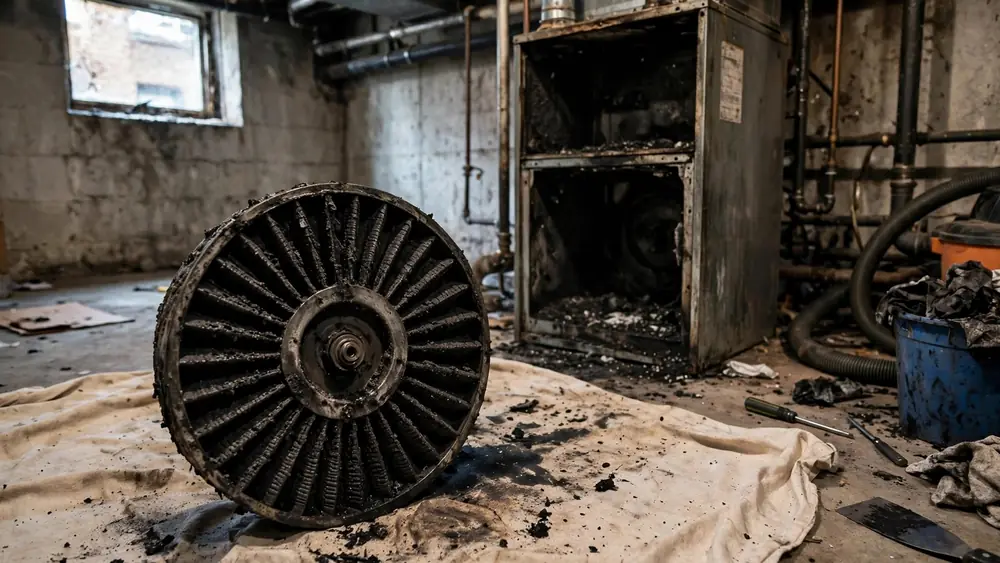
The blower wheel, motor, cabinet and cooling coil are cleaned, since residue there is blown out with every cycle.
- 6
Clean registers and grilles
Covers are removed and cleaned or replaced, and the duct boots behind them are cleaned.
- 7
Replace or remove what cannot be cleaned
Fiberglass duct board, lined ducts and flex duct with heavy residue are usually replaced rather than cleaned [1].
- 8
New filter and system check
A new filter goes in, and a heating professional confirms the equipment is safe before it runs.
Duct types
Duct materials and how they respond to cleaning
What your ducts are made of decides whether they can be cleaned or need replacing.
| Duct type | Common in | Cleanable after smoke? | Notes |
|---|---|---|---|
| Bare sheet metal | Most older Chicago forced-air systems | Usually yes | Brushes and negative-pressure collection work well |
| Fiberglass-lined metal | Some newer or commercial-style systems | Limited | Lining holds residue; heavy contamination usually means replacement |
| Fiberglass duct board | Some additions and newer installs | Limited | No EPA-registered biocides for this material [1]; often replaced |
| Flexible duct | Attic runs, additions, short connectors | Rarely | Thin liner tears easily; normally replaced |
| Building cavities used as returns | Older homes with panned joist returns | Partly | Wood and drywall cavities need cleaning and sometimes sealing |
What you can do yourself
What to do with the heating system while you wait
- Keep the system offRunning it spreads residue and can damage equipment that sat in smoke or water.
- Do not restart utilities yourselfLet the fire department, the utility or a qualified professional confirm gas and power are safe [3].
- Photograph the filter and registersPictures of a blackened filter and stained registers help document the HVAC damage for your insurer [4].
- Cover returns in clean roomsPlastic over return grilles in unaffected rooms limits further spread if anything runs.
- Find your system's detailsNote the furnace age and type and whether it also has central air; it helps the contractor plan.
Local specifics
Forced air, radiators and Chicago heating systems
Heating in Chicago homes varies a lot by building type. Many bungalows and newer single-family homes have gas forced-air furnaces in the basement with metal ductwork running up through the walls [5]. Those systems are the classic case for duct cleaning after a fire, because the basement furnace pulls air from the whole house.
Many greystones, two-flats, three-flats and courtyard buildings heat with boilers and steam or hot-water radiators instead. Radiators do not move air through ducts, so there is no ductwork to clean for heat, but the radiators themselves collect residue and bake odor into it, and they need cleaning along with the walls, as described under soot removal. These buildings may still have ducted central air added later, often with runs through closets or the attic.
Older Chicago homes sometimes use the space between floor joists as a return air path, with sheet metal panned across the joists. Residue settles on the wood and drywall in those cavities, which are harder to clean than metal ducts. High-rise condos usually have individual fan coil units or heat pumps in each unit, plus building-wide ventilation that management controls.
Knowing which system you have shapes the scope. Tell the contractor whether you have forced air, radiators, or both, and whether central air was added.
Diagnosis
Inspecting the system before deciding on cleaning
A good inspection looks at more than the first few feet of duct. The contractor removes registers and the return grille, looks into the plenums above the furnace, inspects the blower wheel and checks the cooling coil if there is one. Cameras on cables can show the inside of longer runs.
They note the type of residue, how far it reached and what the ducts are made of. Light dry soot in bare metal ducts cleans well. Oily residue from a puff-back or a smoldering fire can coat every surface and requires more aggressive cleaning. Lined ducts and flex duct with heavy residue are usually replaced.
The findings, with photos, go into the written scope. If the furnace or air conditioner itself was exposed to heat or water, a heating professional should inspect it separately before it is used.
Quick reference
HVAC symptoms after a fire and what they suggest
| Symptom | What it suggests | Usual action |
|---|---|---|
| Smell only when the system runs | Residue in ducts, blower or coil | Full system cleaning |
| Staining around some registers only | Residue concentrated in certain runs | Clean all runs; focus on those branches |
| Heavy oily film everywhere, no fire seen | Furnace puff-back | Equipment repair plus whole-system cleaning |
| Odor near radiators when heat starts | Residue baked onto radiator surfaces | Radiator cleaning; check nearby walls |
| Smell from flex duct in attic | Residue in thin liner | Replace the flex duct |
Chemicals
Sealants, biocides and fogging in ducts
Some duct cleaning offers include spraying sealants, biocides or deodorants into the ducts. EPA advises caution. It does not routinely recommend duct sealants, notes their health effects are not well understood, and says no biocides are registered for fiberglass duct board or ducts lined with fiberglass [1].
After a fire, removing the residue is what fixes the odor. A deodorizing treatment may be used once the system is clean, as part of the whole-house odor plan, but it should not replace cleaning. Ask exactly what will be applied, why, and whether it is labeled for use in ducts.
Choosing a provider
Picking a duct cleaner for fire damage
Not all duct cleaners are set up for fire work. Routine duct cleaning removes dust; fire cleanup removes soot and residue that can be oily and acidic and that spreads easily if the system is not under negative pressure. Ask whether the company has done fire-related HVAC cleaning before.
EPA suggests choosing providers who follow the standards of the National Air Duct Cleaners Association and, for fiberglass systems, the recommendations of the North American Insulation Manufacturers Association, and being wary of sweeping health claims [1]. NADCA publishes its own standards and member information [6].
Ask how the system will be put under negative pressure, how they will clean the blower and coil, how they will handle lined or flex duct, and how they will show you the result, ideally with before-and-after photos.
DIY or professional
HVAC tasks for owners and for specialists
Owner
Keeping the system off, changing the filter afterward, wiping register covers that come off easily.
Duct specialist
Negative-pressure cleaning of ducts, plenums and boots; replacing contaminated flex duct.
Heating professional
Inspecting the furnace, boiler or air conditioner after heat, smoke or water exposure, and any gas or electrical repairs.
The visit
Timing duct cleaning within the larger restoration
Sequence matters. If the ducts are cleaned before the rooms, residue stirred up during room cleaning can settle back into them. If the rooms are finished first and the system is cleaned last, any residue knocked loose can end up on fresh paint. Most contractors clean the HVAC system after the heavy room cleaning and demolition, then protect the cleaned ducts with sealed registers until the final cleaning is done.
Ask the restoration contractor how they will coordinate the HVAC work with the rest of the job, and whether they do it themselves or bring in a specialist. Make sure the scope your adjuster reviews includes the HVAC system; Illinois guidance recommends getting your adjuster's agreement before contracting for repairs [4].
Prevention
Protecting the heating system in the future
Annual service catches burner problems that can cause puff-backs or soot. Change filters on schedule, and use the filter rating your equipment is designed for. Keep the area around the furnace clear of stored items, which can be both fuel and an obstruction.
Working smoke alarms remain the most important protection, since an early warning means a smaller fire and less smoke in the system [7]. If you ever have a fire, switch off the heating and cooling system as soon as it is safe to reduce how much smoke it pulls through the house.
Clean or replace
When ductwork or equipment should be replaced
Bare metal ducts can almost always be cleaned. Fiberglass-lined ducts, duct board and flex duct with significant residue usually cannot be cleaned effectively and are replaced. Ducts that were exposed to direct heat or damaged by firefighting may also need replacement.
Furnaces, boilers and air conditioners that were exposed to high heat, heavy residue or water need a professional evaluation. Some can be cleaned and returned to service; others are safer replaced. Your adjuster should see the evaluation before the equipment is removed [4].
Questions to ask
Questions to ask a duct cleaning contractor after a fire
- Have you cleaned HVAC systems after fires or puff-backs before?
- Will the system be under negative pressure with HEPA collection the whole time?
- Will you clean the blower, coil and plenums, not just the ducts?
- Which parts of my system will be replaced rather than cleaned, and why?
- Will you apply any chemicals, and are they labeled for ducts?
- Can I see before-and-after photos of the inside of the ducts?
- Who confirms the furnace or boiler is safe to run afterward?
Puff-backs
When the furnace itself caused the soot
Sometimes the heating system is not just a path for smoke but the source. A puff-back happens when an oil burner fails to light cleanly, fuel vapor builds up in the combustion chamber and then ignites all at once. The small explosion forces soot out through the heat exchanger and, if the blower is running, through every duct in the house. Badly adjusted gas equipment can also produce soot, though less dramatically.
After a puff-back, the order of work is different from a fire elsewhere in the house. The equipment is shut down and repaired first by a qualified heating technician, so it does not happen again during the cleanup. Then the entire duct system is cleaned under negative pressure, along with every room and much of the contents, since the soot reached all of them through the vents.
Puff-back soot is oily and spreads with every wipe. It is one of the clearest cases where homeowners should not start cleaning on their own, and where the ducts must be cleaned before the system runs again.
Results
How to tell the duct cleaning worked
The simplest test is the one that revealed the problem: run the system. With a new filter in place, the house closed up and the blower running, there should be no burst of smoke odor and no new staining around registers over the following days and weeks. Ask the contractor to show you before-and-after photos or video from inside the ducts, the blower and the plenums.
Check the filter after a couple of weeks. A filter that turns gray quickly suggests residue is still being released somewhere in the system. Tell the contractor promptly; it is far easier to fix a missed section while the job is fresh than months later.
FAQ
Duct cleaning after a fire: questions
Do I need my ducts cleaned after a small fire?
If the system was running during the fire, if registers show staining, or if the house smells of smoke when the blower runs, the ducts should be inspected and likely cleaned. A small fire far from any return grille may not need it.
Can I run the furnace after a fire?
Not until the system has been checked. Running it can spread residue through the house, and equipment exposed to heat, smoke or water may be unsafe.
How is duct cleaning after a fire different from regular duct cleaning?
Fire residue can be oily and acidic and spreads easily, so the system is kept under negative pressure with HEPA collection, and the blower, coil and plenums are cleaned along with the ducts.
Can flexible duct be cleaned after smoke exposure?
Usually not well. Flex duct has a thin inner liner that holds residue and tears easily, so smoke-contaminated flex duct is normally replaced.
My building has radiators. Do I still need HVAC cleaning?
Radiators have no ducts, but they collect residue and need cleaning. If central air was added with ductwork, those ducts may also need cleaning.
Should the ducts be sprayed with a sanitizer or sealant?
EPA does not recommend these as routine treatments, and no biocides are registered for fiberglass duct board or lined ducts. Removing the residue is what fixes the problem.
Does insurance cover duct cleaning after a fire?
It is often part of a covered fire loss when smoke reached the system, but every policy differs. Include the HVAC system in the documented scope and ask your adjuster.
How long does duct cleaning take after a fire?
A typical single-family forced-air system is often cleaned in a day. Larger homes, heavy oily residue from a puff-back, or replacing sections of lined or flex duct can extend that to two days or more.
Will a new furnace filter fix the smoke smell?
A new filter helps catch loose particles, but it does not remove residue already coating the ducts, blower and coil. If the smell returns when the system runs, the system itself needs cleaning.
Should the air conditioner coil be cleaned too?
Yes, if the system carried smoke. The coil sits in the airflow and catches residue on its fins, then releases odor whenever the air conditioning runs.
Sources and citations
- [1]U.S. EPA — Should you have the air ducts in your home cleaned?
- [2]IICRC — ANSI/IICRC S700 Standard for Fire and Smoke Damage Restoration
- [3]Ready.gov — Home fires
- [4]Illinois Department of Insurance — What to do after an insured homeowners loss
- [5]Wikipedia — Chicago bungalow
- [6]National Air Duct Cleaners Association
- [7]NFPA — Smoke alarms