

Key facts: Soot Removal in Portage Park and Jefferson Park
Basement joists
Soot on the open joists above a bungalow basement
In an unfinished bungalow basement, the joists and the underside of the main floor are exposed. Soot from a basement fire or puff-back settles thickly on that rough wood. It is HEPA vacuumed first, then cleaned with dry sponges or, for heavy deposits, soda or dry-ice blasting under containment.
Cleaned joists are often sealed with a stain- and odor-blocking primer so remaining residue cannot release smell into the floor above.
Puff-backs
Furnace puff-backs in older Northwest Side homes
A burner that misfires can push soot through the heat exchanger and out of every register. The house can be coated in an oily film overnight without any flames. The heating equipment is repaired first, then the ducts and every room are cleaned, dry methods before wet.
Brick
Soot on face brick and basement walls
Bungalows are mostly brick [1]. Soot from a basement fire stains the inside of the foundation walls, and smoke from windows darkens the face brick outside. Old brick and mortar can be eroded by pressure washing, so crews use HEPA vacuuming and masonry-safe cleaners tested in a corner.
Hidden soot
Where soot hides in a Northwest Side bungalow
- Top of the foundation wall and sill plate
- Inside the furnace cabinet and return ducts
- Behind knee walls in the half-story
- Window channels and storm windows
- Tops of door frames and built-ins
Plaster
Plaster walls and ceilings upstairs
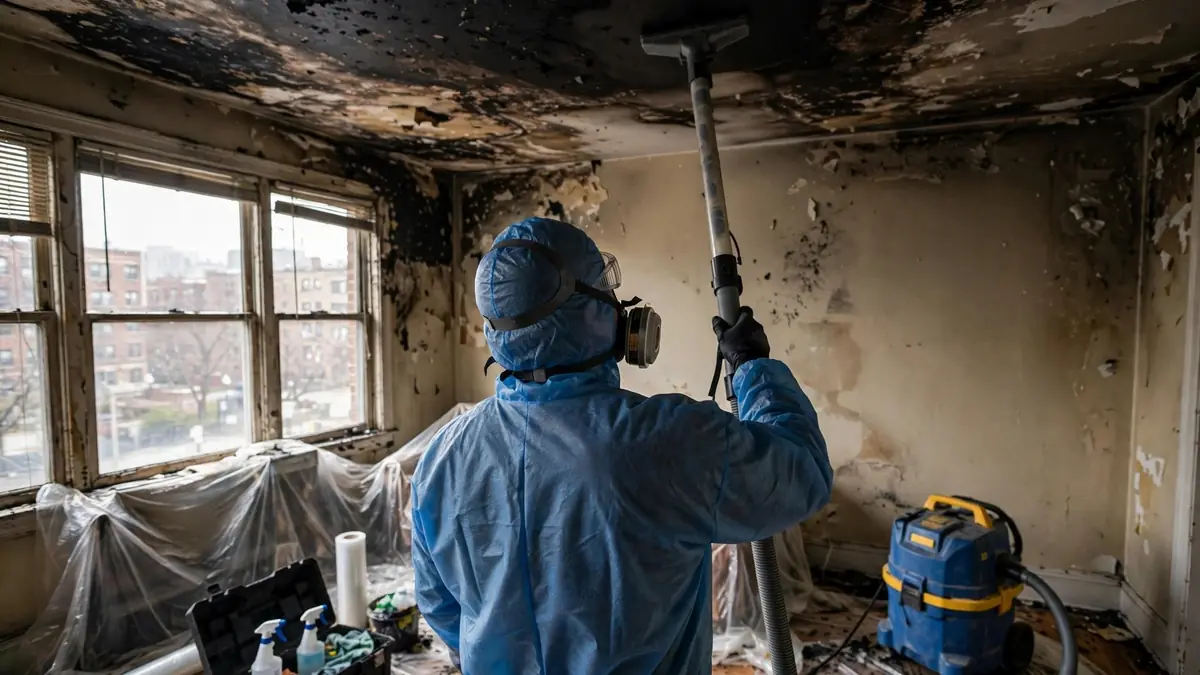
Main-floor and half-story rooms usually have plaster. Soot is lifted with dry chemical sponges, then washed with cleaners suited to the residue. Ceilings come first so falling soot never lands on finished walls.
Half-story
Soot behind the knee walls
Soot that rises into the half-story settles in the attic spaces behind the knee walls and above the sloped ceilings. Insulation there is usually removed, and the rafters cleaned and sealed. Asbestos testing comes first if old insulation is present [4].
Garages
Detached garage fires along the alley
Most bungalows have a detached garage at the back of the lot. A garage fire can blacken the rear of the house, the back porch and the alley fence. Exterior soot is cleaned material by material; any soot that came through rear windows is treated inside.
Health
Protecting the household during cleanup
Disturbed soot becomes airborne. Crews seal off work areas with plastic, run HEPA air scrubbers and keep the basement under negative pressure so soot is not pulled up into living areas [2].
Records
Photographing soot first
Photograph the soot pattern in the basement and every room before cleaning. The Illinois Department of Insurance recommends photos before cleanup and keeping receipts [5].
Prevention
Keeping soot from happening again
Service the furnace or boiler every year, clean the dryer vent regularly and keep the area around the furnace clear of stored items. Working smoke alarms in the basement catch a smoldering fire early.
Dryer and workshop fires
Common soot sources in Northwest Side basements
Dryer fires, often from lint-clogged vents, and workshop fires among stored paint, solvents and wood scraps are frequent in bungalow basements. Both produce heavy, oily soot because they burn materials like plastics, finishes and lint in a closed space. The soot coats the joists, ducts, water heater and anything stored nearby.
Oily soot spreads with every wipe, so it is removed with HEPA vacuuming and degreasing cleaners rather than water. Stored items with heavy soot are sorted: metal tools often clean well, while boxes, fabric and cardboard usually do not. Have the dryer vent cleaned and inspected before the dryer is used again.
Timeline
How long soot removal takes in a bungalow
Light soot confined to one floor may take a few days. A basement fire or puff-back that reached every room and the ducts usually takes longer, often a week or more before repairs begin, because each floor, the half-story spaces and the HVAC system all need work in sequence.
Choosing a crew
Questions for a Northwest Side soot contractor
Ask how they will contain soot in the basement so it is not pulled upstairs, whether they will clean the joists or blast them, how they test cleaners on plaster and brick, and whether their crew is certified for lead-safe work in pre-1978 homes. Ask to see test patches before they scale up, and ask whether duct cleaning is part of their scope or handled by a separate company.
Signing for soot cleanup does not commit you to the same company for repairs. Get your adjuster's agreement on the scope first.
FAQ
Northwest Side soot questions
Can soot be cleaned off my basement joists?
Yes. They are HEPA vacuumed, cleaned or blasted under containment and often sealed afterward.
What is a furnace puff-back?
A burner misfire that pushes soot through the heat exchanger and ducts into the house, often without visible flames.
Can I pressure wash soot off my bungalow's brick?
It is not recommended. Old brick and mortar can be eroded. Masonry-safe cleaning is gentler.
Why is there soot in my half-story attic?
Soot rises up the stair and into the spaces behind the knee walls and above the sloped ceilings.
Does soot affect the other unit in my two-flat?
Often, especially after a basement fire, since the basement is shared and soot rises through floors and the stair.
Is soot cleanup dangerous?
Soot is fine particulate, so crews use respirators, containment and HEPA air scrubbers.
Can stored tools in my basement be cleaned after soot?
Metal tools usually clean well once soot is wiped off and moving parts are serviced. Cardboard boxes, fabric and paper with heavy soot are usually discarded after the adjuster sees them.
Do soot-covered joists have to be replaced?
Rarely. Surface soot and light charring can usually be cleaned and sealed. Deeply charred joists need assessment by a qualified professional before anyone decides.
Should I run the furnace while soot is being cleaned?
No. Keep it off until the ducts are cleaned, or it will spread soot into rooms the crew has finished.
Is soot from a puff-back covered by insurance?
Many homeowners policies treat a puff-back as a covered event, but each policy differs. Photograph the soot before cleaning and ask your insurer.