
Key facts: Soot Removal in Lakeview
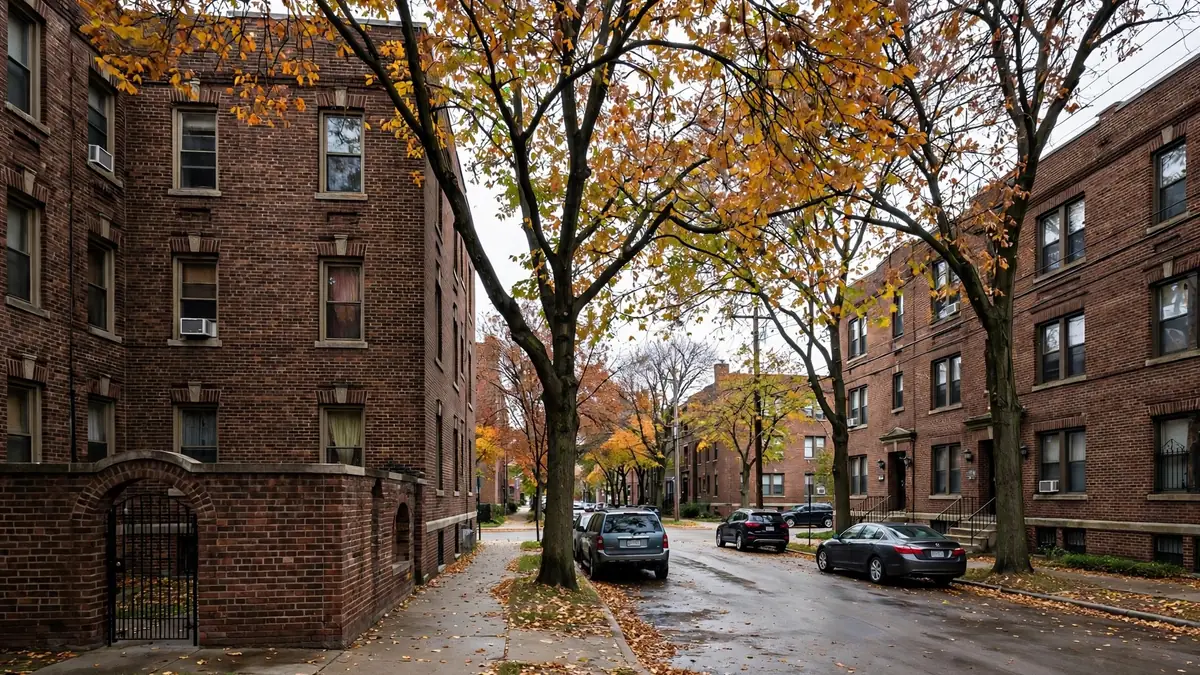
- More than 40% of Lake View's buildings date from the boom around its 1889 annexation, so plaster, old brick and vintage woodwork are common [1].
- Soot particles are fine enough to reach deep into the lungs, according to EPA [2].
- Older frame houses may be balloon framed, with wall cavities running from basement to attic that carry soot upward [3].
Radiators
Steam heat and soot in Lakeview's vintage buildings
Many courtyard buildings, walk-ups and older two-flats in Lakeview still heat with central boilers and cast-iron radiators. Radiator fins trap soot in narrow gaps, and once the heat comes on, that residue bakes onto the metal and releases a fresh wave of smell. A building that seems clean in September can smell burned in October.
Radiators are cleaned as part of soot removal, not afterward: vacuumed, brushed between the fins and wiped with cleaners suited to the residue. In a building with a central boiler, ask the owner to keep heat off in the affected stack until the radiators are done, if the season allows.
Frame houses
Soot inside the walls of Wrigleyville and West Lakeview houses
West of Clark Street, the frame houses and two-flats of Wrigleyville and West Lakeview include older buildings that may use balloon framing, with studs running continuously from the sill to the roof [3]. A basement or first-floor fire can send soot straight up those channels into the attic without crossing a single room.
Contractors check the tops of interior walls, the attic floor and the space around plumbing stacks. Soot found there means wall cavities need opening, cleaning and sealing; testing for lead paint and asbestos comes first in a house of that age [4][5].
Masonry
Exposed brick and limestone in Northalsted walk-ups
Renovated flats in older Lakeview walk-ups often have exposed common brick inside, and greystone fronts are Indiana limestone. Both hold soot in their texture. Old brick is soft enough to be eroded by pressure washing, and limestone reacts badly to acidic cleaners.
The usual approach is HEPA vacuuming, then dry sponging where possible, then a masonry-safe cleaner tested on a hidden spot. Sealing exposed brick afterward makes future cleaning easier.
Hidden soot
Places soot hides in Lakeview's older buildings
- Between radiator fins and behind radiator covers
- Tops of tall door frames and picture rails
- Window channels in double-hung and storm windows
- Attic floor above balloon-framed walls
- Mortar joints in exposed brick walls
Health
Keeping soot out of neighboring units during cleanup
Soot disturbed during cleaning becomes airborne again, and EPA notes that fine particles can aggravate asthma and heart conditions [2]. In a courtyard building or walk-up, neighbors share stairs and sometimes ventilation, so containment matters for them too.
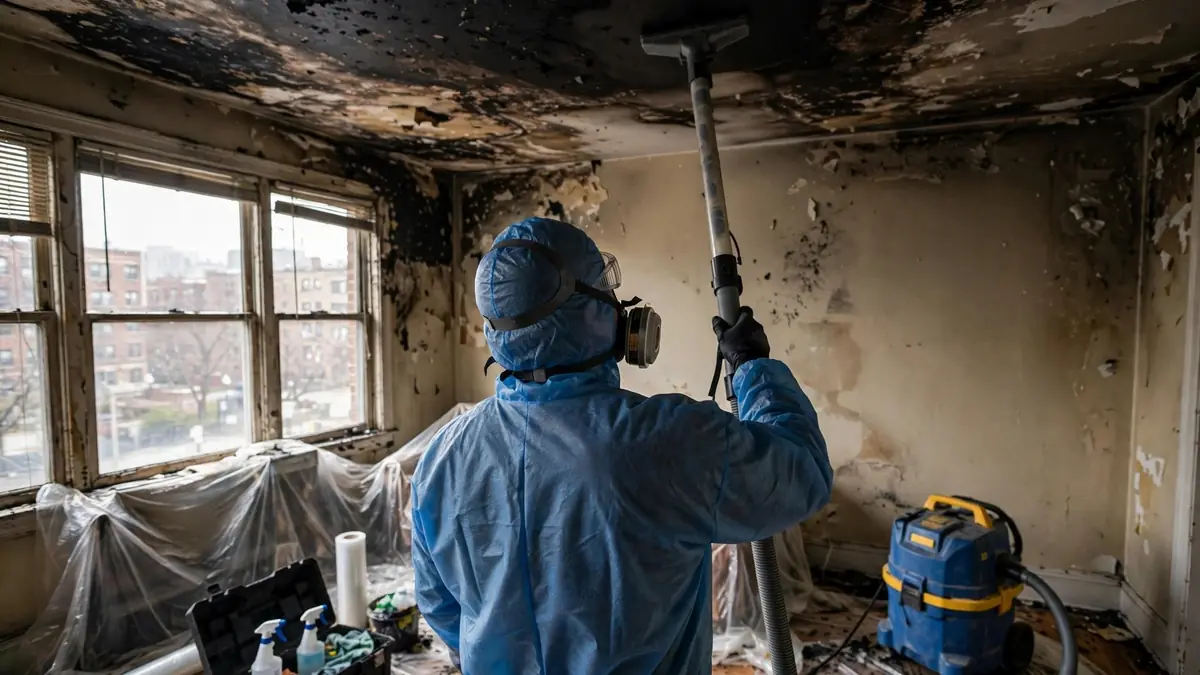
Expect the crew to seal doors to the stair with plastic, run HEPA air scrubbers and keep the work area under slight negative pressure. Tell them if a neighbor has a respiratory condition.
Repairs
When soot removal turns into rebuilding
Charred drywall, soot-soaked insulation and acoustic ceiling tiles are removed rather than cleaned. Once materials come out, replacing them in Lakeview goes through the Chicago Department of Buildings when a permit is required [6].
If the building is in one of Lakeview's landmark districts, exterior repairs such as new windows may also need review. Interior soot removal can proceed regardless.
Records
What to keep for the claim
Photograph the soot pattern before cleaning: it shows the adjuster how far the residue traveled. The Illinois Department of Insurance advises keeping receipts for every repair and not discarding damaged items before the adjuster sees them [7].
In multi-unit buildings, note which units share the stair or ventilation with the fire unit, since those are the ones most likely to need soot work.
Puff-backs
Furnace puff-backs in Lakeview houses and two-flats
Not every heavy soot problem in Lakeview starts with a fire you can see. In houses and two-flats with older heating equipment, a burner that misfires can push soot through the heat exchanger and out of every register in the house, leaving an oily film on walls, ceilings and belongings overnight.
After a puff-back, the heating equipment is repaired first so it cannot happen again, then the ducts and every room are cleaned. Oily puff-back soot spreads with each wipe, so it is a job for HEPA vacuuming, dry sponging and degreasing cleaners in that order, not a bucket and sponge.
Fireplaces
Chimney soot in vintage Lakeview homes
Some older Lakeview houses and larger flats still have working fireplaces. A chimney fire, usually from creosote in a flue that has not been swept, can crack the liner and deposit soot around the mantel, the nearby walls and sometimes the attic around the chimney stack. Shared chimney stacks in attached buildings can affect neighbors too.
The chimney should be inspected before the fireplace is used again. Cleaning the surround calls for masonry-safe methods on brick or stone and gentle cleaners on painted or carved wood mantels.
Order of work
Why Lakeview soot jobs start at the top floor
Soot follows hot smoke upward, so in a stacked Lakeview building the heaviest deposits are often on the top floor and the ceiling of the stair. Crews clean from the top down so falling residue never lands on finished work below.
FAQ
Lakeview soot removal questions
Why does my Lakeview apartment smell burned when the radiators come on?
Soot settled on the radiator fins and bakes when they heat up. The radiators need to be cleaned along with the walls.
Can soot be cleaned off the exposed brick in my Lakeview flat?
Usually, with HEPA vacuuming and masonry-safe cleaners. Avoid pressure washing old common brick, which can erode it.
How did soot get into the attic of my Wrigleyville house?
Older frame houses may be balloon framed, with open wall cavities from the basement to the attic that let soot and smoke travel upward inside the walls.
Is soot cleanup in a shared building a risk to my neighbors?
It can be if dust escapes into the stair. Crews use containment and HEPA air scrubbers to keep soot inside the work area.
Does soot removal need a permit in Lakeview?
Cleaning does not. Replacing drywall, wiring or other building parts afterward may need a Chicago building permit.
Do I need a chimney inspection after a fireplace fire in my Lakeview home?
Yes. A chimney fire can crack the flue liner and reach the attic or neighboring flues. Have a qualified chimney professional inspect it before the next fire.
Should I vacuum soot with my household vacuum?
No. Household vacuums blow fine soot back into the air. HEPA-filtered equipment is needed.
Sources and citations
- [1]Wikipedia — Lake View, Chicago
- [2]U.S. EPA — Particulate matter basics
- [3]Wikipedia — Balloon framing
- [4]U.S. EPA — Lead Renovation, Repair and Painting Program
- [5]U.S. EPA — Protect your family from exposures to asbestos
- [6]City of Chicago — Department of Buildings permits
- [7]Illinois Department of Insurance — What to do after an insured homeowners loss