
Key facts: Structural Drying in Portage Park and Jefferson Park
Basements
Drying the basement and foundation
The basement collects water from above. Concrete floors and masonry walls dry well but slowly, and finished walls usually come out so they can. Dehumidifiers and air movers run around the clock with daily readings.
Joists
Drying the joists and subfloor
The joists and subfloor above the basement soak up water from the main floor. Air movers aimed at the underside and dehumidifiers in the basement dry them. Readings are taken in the wood itself.
Floors
Oak floors on the main floor
Oak flooring cups when wet. Floor drying mats pull moisture up through the boards. Refinishing waits until boards, subfloor and joists read normal.
Checklist
Drying checklist for a bungalow
- Dry standards set for each material
- Basement finishes removed if wet
- Joists and subfloor monitored daily
- Oak floors dried before refinishing
- Pipes protected in winter
Plaster
Plaster walls and ceilings
Plaster holds water and dries slowly. Controlled drying protects it from cracking. Sagging ceilings are drained or removed for safety.
Two-flats
Drying both units of a two-flat
Water from the upper unit soaks the lower unit's ceiling and walls. Both units and the basement are dried on one plan.
Winter
Drying in a cold house
If the furnace is out in winter, temporary heat or desiccant dehumidifiers keep drying going while the pipes are protected.
Lead
Opening walls safely
When walls must be opened, lead-safe practices apply in pre-1978 homes [4].
Records
The drying log
Daily readings and photos show the insurer the house was dried properly [5].
Mold
Checking afterward
Check the basement and closets a few weeks later for musty smells or spots.
Half-story
Water in the half-story and knee walls
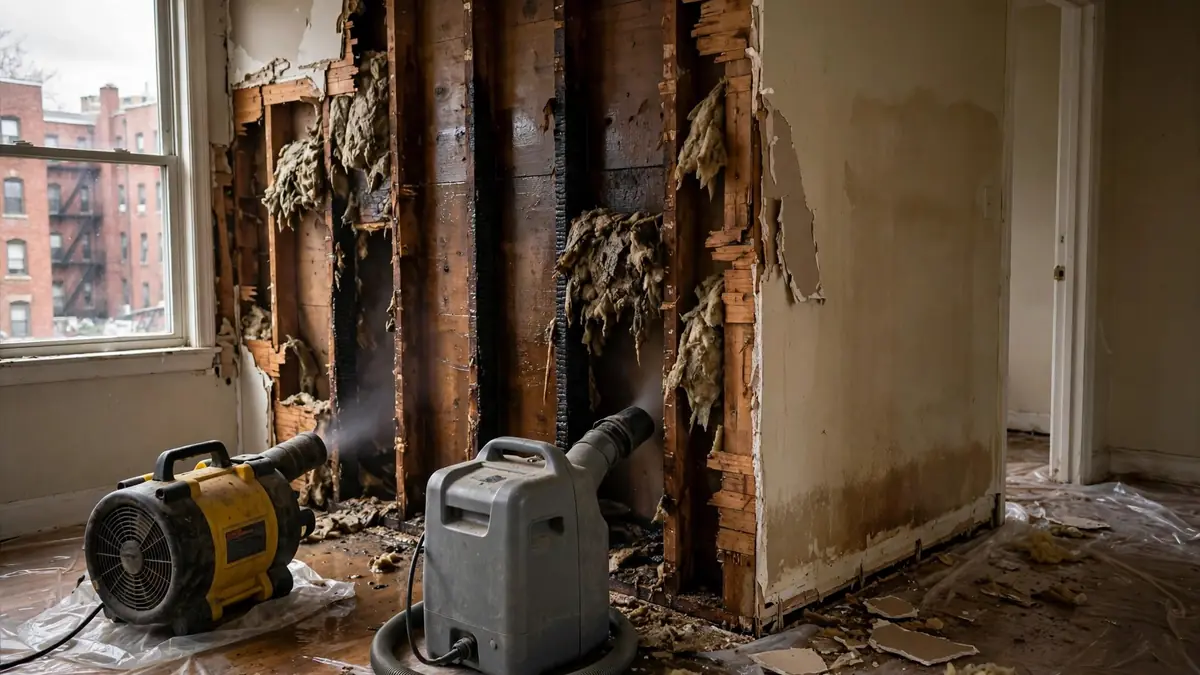
When a fire is fought in a bungalow's half-story, water soaks the floor, runs into the knee-wall spaces and down through the main floor ceilings. The insulation behind knee walls holds water and is usually removed so the framing can dry.
Ceilings below the half-story are checked for sagging; plaster that stays bonded is dried slowly in place.
Power
Running drying equipment safely
Dehumidifiers and air movers draw a lot of power. They should run only from circuits an electrician has confirmed safe, or from temporary power, especially when the panel sits in a wet basement.
Contents
Belongings and drying
Stored belongings left on a wet basement floor block drying and grow mold. They are moved, packed out or discarded after the adjuster sees them. Wet papers and photos can be frozen until they can be dried professionally.
Choosing a crew
Questions for a drying contractor
Ask how they set dry standards for concrete, wood and plaster, how often readings are taken, how equipment will be powered and whether they will share the daily log. Ask how they will protect plaster and oak from over-drying.
Timeline
A typical bungalow drying job
Day one: extraction, removal of wet basement finishes, equipment setup. Following days: readings and adjustments, with equipment concentrated where readings stay high. Basement masonry and oak floors usually set the pace.
Neighbors
Water that reached the house next door
On narrow Northwest Side lots, hose water can pour into a neighbor's window wells or soak the side of their house. The neighbor's basement may need drying too. Each owner documents and claims their own damage, and one crew drying both basements at once often finishes faster.
Mold watch
Checking for mold after drying
Check the basement, closets and under sinks a few weeks after the equipment leaves. A musty smell or spots on the back of a closet wall suggest moisture stayed. EPA advises fixing moisture sources quickly and getting professional help for larger areas [2].
Proof
Keeping the drying record
Keep the moisture map, the daily readings and the photos with your house records. They show your insurer the house was dried properly, and future buyers or inspectors may ask about past water damage.
Plaster
Keeping plaster in the main rooms
Plaster walls in bungalow living and dining rooms are worth keeping. They hold water but usually dry in place if they stay bonded to the lath. Crews check for hollow areas and dry slowly, avoiding high heat that cracks plaster. Where a section has come loose, it is removed and patched rather than tearing out the whole wall.
FAQ
Northwest Side drying questions
How long does it take to dry a bungalow basement?
Often several days to two weeks, depending on how long water sat and the weather.
Can my oak floors be saved?
Often, with floor drying and refinishing once readings are normal.
Do finished basement walls have to come out?
Usually, so the foundation can dry.
Can drying happen without heat in winter?
Yes, with temporary heat or desiccant dehumidifiers.
How do I know the house is dry?
When readings match dry materials of the same type.
Will drying crack my plaster?
Controlled drying is designed to prevent that.
Do knee-wall spaces need drying after a fire upstairs?
Yes. Insulation there holds water and is usually removed so the framing can dry.
Can drying equipment run off my basement panel?
Only if an electrician confirms it is safe; otherwise temporary power is used.
How do I know my basement is really dry?
When readings in the concrete, masonry and wood match readings from dry areas of the same materials. Ask for the log.
Will mold grow after drying?
Not if materials were dried promptly and fully. Check closets and the basement a few weeks later to be sure.
Will my plaster walls have to be torn out?
Usually not. Plaster that stays bonded can be dried in place; only loose sections are removed and patched.
Why are baseboards removed during drying?
Removing them lets air reach the bottom of the wall and the floor edge. They can usually be reinstalled.
How long will the drying equipment be in my bungalow?
Often several days to two weeks. Basement masonry and oak floors usually take longest, and cold weather slows everything down.
Can I stay home while my basement is dried?
Often, if the main floor is safe and the utilities work. The equipment is loud and runs around the clock, so some families stay elsewhere for the first days.
Does the drying crew handle mold?
They aim to prevent it by drying promptly. If growth appears, small areas can be cleaned; EPA advises professional help for larger areas.
Do I need to empty my basement before drying starts?
Wet belongings and anything blocking airflow should be moved, packed out or set aside for the adjuster, so the floor and walls can dry evenly.
Sources and citations
- [1]IICRC — ANSI/IICRC S500 Standard for Professional Water Damage Restoration
- [2]U.S. EPA — A brief guide to mold, moisture and your home
- [3]Wikipedia — Chicago bungalow
- [4]U.S. EPA — Lead Renovation, Repair and Painting Program
- [5]Illinois Department of Insurance — What to do after an insured homeowners loss