
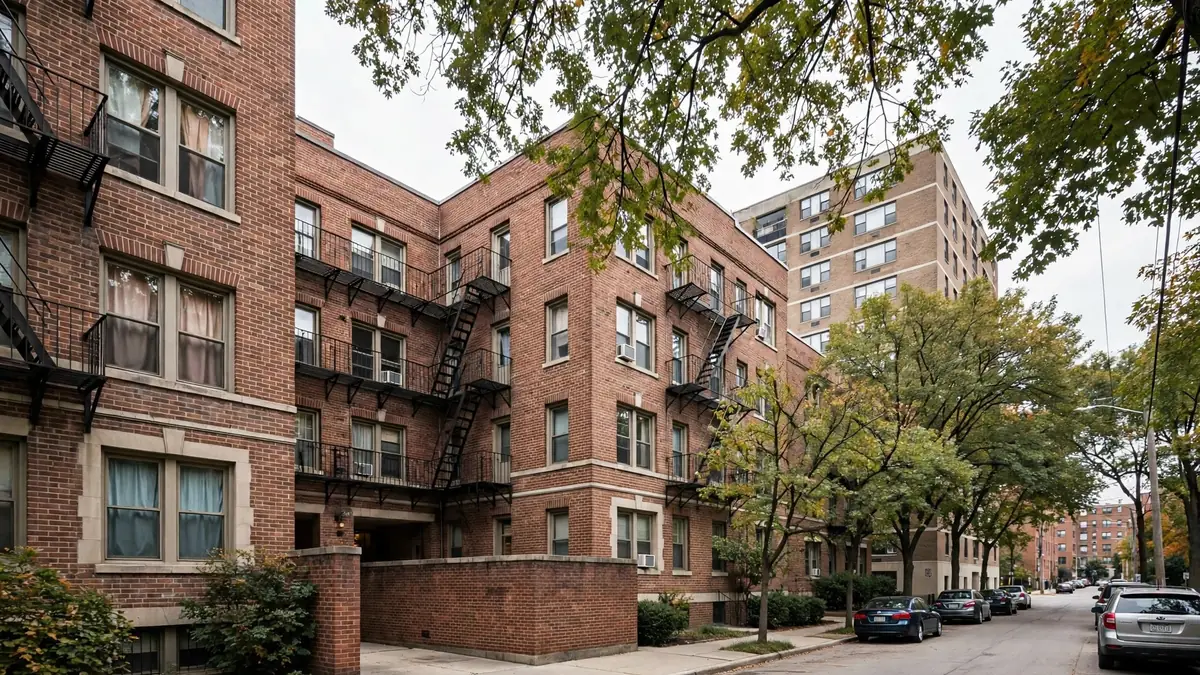
Key facts: Odor Removal in Uptown and Edgewater
Shared stairs
Odor that comes from the stair
In six-flats and courtyard buildings, the stair connects every unit on it [1]. If its walls, ceilings and the rear porch enclosures were not cleaned, they release odor into each unit whenever a door opens. Residents notice it most in their entry halls and closets near the front door.
Cleaning the stair is the owner's job. A written request from tenants, with dates and places, helps get it done.
Towers
Risers and corridors in Sheridan Road towers
In a high-rise, odor that survives unit cleaning often comes through kitchen and bathroom exhaust risers, corridor ventilation or the trash chute. These are building systems. If smell appears when a neighbor's fan runs, the riser is a likely path; report it to management so the engineer can trace it.
Your own fan coil or heat pump unit may also hold residue and should be cleaned [3].
Radiators
The first heating day
In buildings with radiators, the first cold day of the season is the real test. Residue on the fins bakes and smells. If your unit smells fine until October, the radiators need another cleaning.
Clues
Where to sniff in an Uptown or Edgewater unit
- Under your front door, facing the stair or corridor
- Bathroom and kitchen exhaust fans
- Radiators on the first heating day
- Closets on shared walls
- Rear porch doors
Treatments
Treatments in occupied buildings
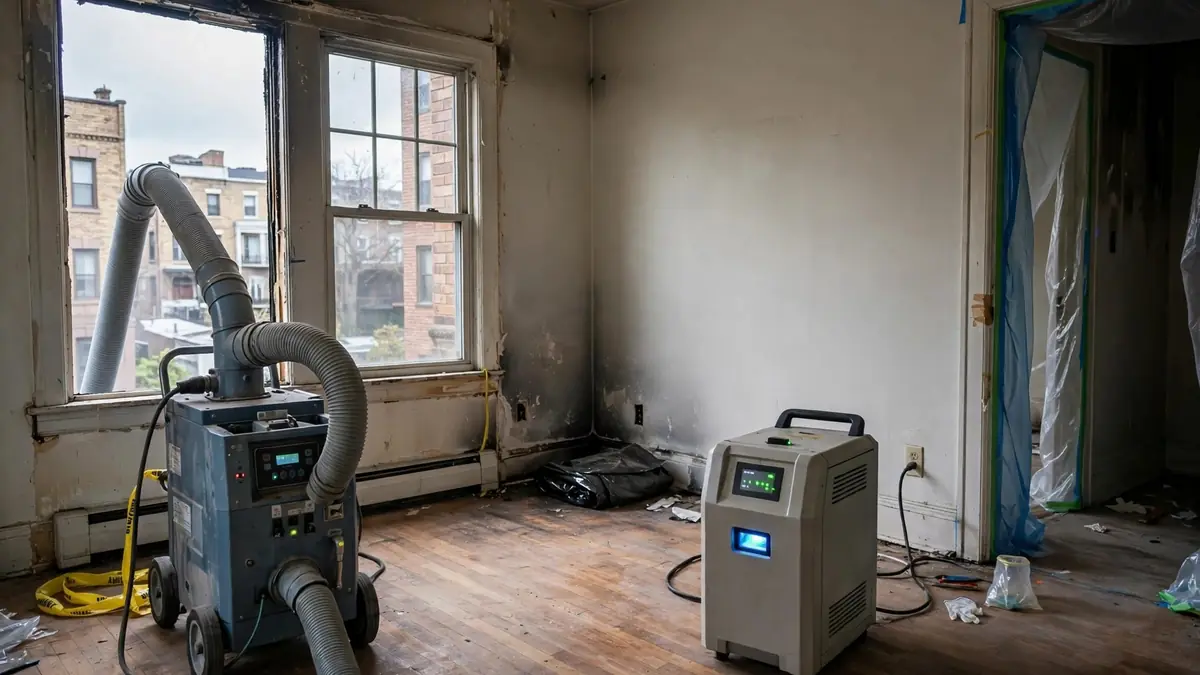
Hydroxyl units and carbon filtration can usually run with people present. Thermal fogging needs the space empty. Ozone requires an unoccupied, sealed space, and EPA warns it damages rubber, fabrics and artwork [2]. Because ozone and fog can drift through shared stairs and corridors, many contractors avoid them in occupied buildings.
Restaurants
Restaurant odor in apartments above
Apartments above restaurants on Broadway, Argyle or Clark can hold greasy protein residue after a kitchen fire. That smell does not fade until every surface it reached is degreased, including cabinets inside and out and the stair.
Lake humidity
Why smells return in summer
Near the lake, humid summers make residue in plaster, wood and fabric release odor faster. A unit cleaned in winter can smell again in July, signaling a missed source.
Contents
Fabrics and furniture
Clothing, curtains and upholstered furniture absorb odor while residue remains in the building. Laundering for smoke usually works on fabrics; foam cushions and mattresses with deep odor may not.
Renters
Renters and persistent odor
Most residents rent. If smell persists after the landlord's cleaning, write it down and send it to the landlord. Your own belongings are covered by your renter's insurance [4].
Verification
Checking the result
Close the unit up for a day or two and check with the heat on and again on a humid day. Report any returning smell promptly.
Apartment hotels
Odor in co-ops and apartment hotels
In Margate Park's converted apartment hotels, long corridors and central systems spread odor between many units. If your unit was cleaned but still smells, the source may be the corridor carpet, the ventilation or a neighboring unit. The co-op board or association controls those spaces and has to arrange their cleaning.
Write to the board with the dates and places you notice the smell. That record helps the board's contractor find the source.
Houses
Odor in Edgewater and Buena Park houses
Single-family houses can hold odor in attic insulation, wall cavities and basement joists. Older frame houses may let smoke rise inside the walls to the attic. Insulation that absorbed smoke is removed, framing is cleaned and sealed, and only then is the remaining odor treated.
Order of work
Why treatment comes last
Treating odor before the sources are cleaned or removed only masks it for a few weeks. The order is: remove what cannot be cleaned, clean every surface and the shared spaces, clean the HVAC, seal stained framing, then treat.
Belongings
Fabrics and furniture holding smell
In small apartments, clothing, bedding and upholstered furniture sit close to every wall and absorb smoke smell for as long as residue remains in the building. Laundering made for smoke usually clears fabrics. Foam cushions and mattresses with deep odor may not recover. A pack-out keeps cleaned items away while the unit and shared spaces are treated, so nothing is re-exposed. Keep damaged items for the adjuster before disposal.
Checking the result
Testing a unit for odor
Ask the contractor to check the result with the unit closed for a day or two, the heat or air running and the stair or corridor door shut. In buildings with radiators, the first cold day is the true test. Keep notes of where any smell returns; a missed source is easier to fix while the job is fresh.
FAQ
Uptown and Edgewater smoke odor questions
Why does my apartment smell of smoke when the fire was elsewhere in the building?
Smoke traveled through the shared stair, corridor or ventilation. Those spaces need cleaning by the building.
Can ozone be used in my six-flat?
Only in an empty, sealed space. In occupied buildings many contractors use hydroxyl units instead.
Why does the smell come back with the heat?
Residue on radiator fins bakes when they heat up.
Who fixes odor coming from an exhaust riser?
The building, since risers are shared systems. Report it to management.
Do air purifiers help?
A HEPA purifier with carbon reduces airborne odor but cannot remove residue in walls or fabric.
How long does odor removal take?
With sources cleaned, often days to a few weeks.
Is Rogers Park covered as well as Uptown and Edgewater?
Odor work through this site covers Uptown 60640 and Edgewater 60660. North of Devon Avenue, Rogers Park falls outside that list.
Who fixes odor in my co-op corridor?
The co-op board, which controls common areas. Put your concerns in writing.
Will repainting get rid of smoke smell?
Yes, but clean first, then use an odor-blocking primer before the paint.
Can my clothes be saved from smoke smell?
Most clothes recover, though it may take more than one round of laundering or dry cleaning meant for smoke.
How long until my apartment stops smelling of smoke?
With sources cleaned, usually days to a few weeks. Shared spaces and radiators can stretch that until they are done.
Do air purifiers help?
A HEPA purifier with activated carbon can reduce airborne odor but cannot remove residue in walls, radiators or fabric.