

Key facts: Odor Removal in Portage Park and Jefferson Park
Knee walls
Odor behind the half-story knee walls
The half-story of a bungalow has short knee walls with storage spaces behind them and insulation in the sloped ceilings above. Smoke that rose up the stair settles there. Residents often notice odor strongest in the upstairs bedrooms, especially on warm days.
The fix is to open the access panels, remove smoke-soaked insulation, clean and seal the rafters and then reinsulate. Deodorizing the bedrooms without doing that only buys a few weeks.
Ducts
When the furnace brings the smell back
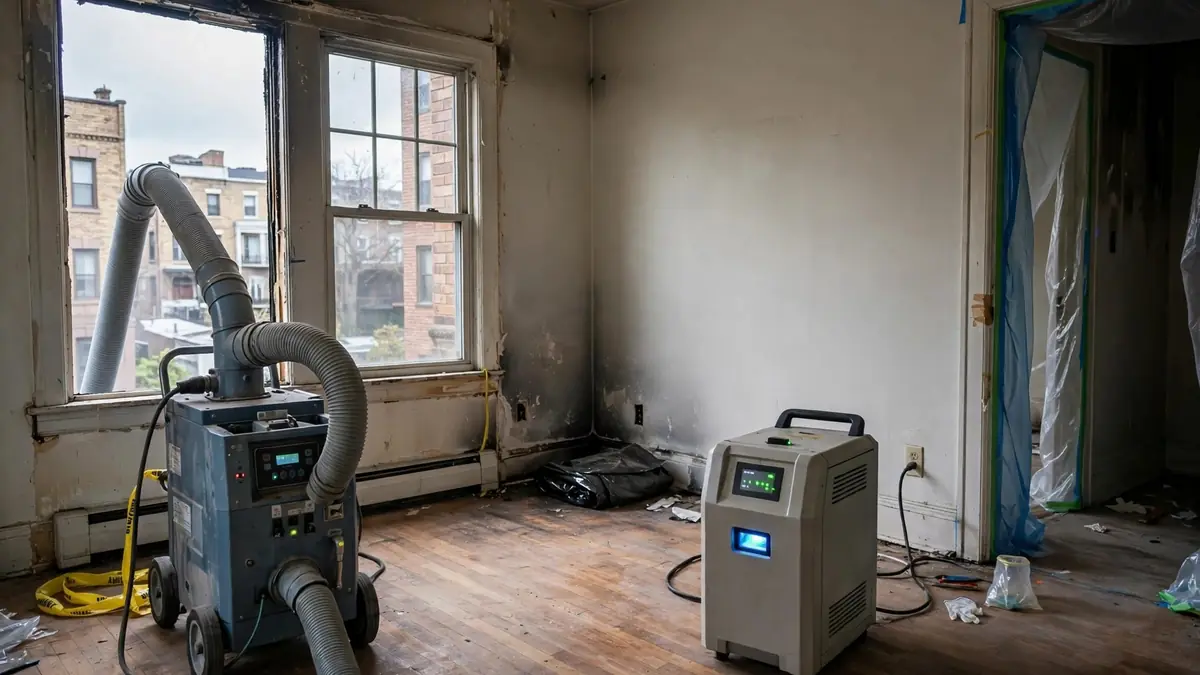
If odor rises when the blower starts, residue is in the ducts, blower or coil. Cleaning the system under negative pressure, then fitting a new filter, usually solves it. EPA advises fixing the underlying cause first and avoiding unnecessary chemicals in ducts [3].
Basements
Basement joists and stored belongings
Soot and smoke on the basement joists release odor into the floor above. Stored boxes, old furniture and clothing in the basement also hold smell. Cleaning and sealing the joists and sorting stored belongings removes two common sources at once.
Clues
Where to sniff in a bungalow or two-flat
- Upstairs bedrooms near the knee walls
- Registers when the furnace starts
- Basement near the joists
- The enclosed front porch
- The shared stair in a two-flat
Porches
Enclosed front porches
A fire on an enclosed front porch leaves residue in the porch walls, ceiling and windows, and smoke enters the living room through the front door. Odor can linger in the porch long after the main house is clean. The porch may need its own cleaning or partial rebuilding.
Treatments
Choosing a treatment for a family home
Hydroxyl units and carbon filtration can usually run while the family is home. Thermal fogging needs the house empty for a time. Ozone requires an unoccupied home with pets and plants removed, and EPA warns it can damage rubber, fabrics and artwork [2].
Two-flats
Odor between the units of a two-flat
In a two-flat, the shared stair and basement can carry odor from one unit to the other. If one unit is clean but still smells, check the stair and the basement before treating again.
Humidity
Why the smell returns in summer
Chicago summers are humid, and humidity makes residue in plaster, wood and insulation release odor faster. A house cleaned in winter may smell again in July, which signals a missed source rather than a failed job.
Contents
Clothing and furniture
Fabrics usually respond to laundering made for smoke. Foam cushions and mattresses with deep odor may need replacing. A contents pack-out keeps cleaned items away while the house is treated.
Claims
Documenting persistent odor
Write down where and when the smell appears. The Illinois Department of Insurance advises keeping damaged items, including smoke-smelling furniture, for the adjuster [4].
Verification
Checking the result
Close the house for a day or two, run the heat or air, and check again on a humid day. Report any returning smell promptly.
Garages
Smoke smell after a detached garage fire
When a detached garage burns, smoke often drifts into the house through rear windows, the back door and attic vents. The house may have no visible damage yet smell strongly in the kitchen and rear bedrooms. Fabrics near those openings, curtains and bedding especially, absorb the odor first.
Cleaning the rear rooms, laundering affected fabrics and running air filtration usually clears it. If the smell persists, the attic and the insulation near the rear vents are the next places to check.
Renters
Odor in a rented two-flat unit
If you rent one unit of a two-flat and the smell persists after the owner's cleaning, put your concerns in writing with dates and places. That record helps the owner's contractor find the source and supports any claim on your own renter's insurance.
Order of work
Why odor treatment comes last
In a bungalow, the sequence is: remove smoke-soaked insulation from the half-story, clean and seal the basement joists, clean every room top to bottom, clean the ducts, then treat whatever odor remains. Treating before the sources are gone just masks the smell for a few weeks.
Ask the contractor to show you the order on the written scope so you and your adjuster can follow it.
Belongings
Odor in fabrics and furniture
Curtains, bedding, rugs and upholstered furniture absorb smoke smell for as long as residue remains in the house. Laundering made for smoke usually clears fabrics. Foam cushions and mattresses with deep odor may not come back and are judged one by one, with the adjuster seeing them before disposal.
FAQ
Northwest Side odor questions
Why do my bungalow's upstairs bedrooms still smell smoky?
Residue in the insulation behind the knee walls and above the sloped ceilings. It has to be removed and the framing sealed.
Can ozone be used in my house?
Only if the house is empty, including pets and plants. EPA warns it can damage materials and is not reliable at safe levels.
Why does the smell come back when the furnace runs?
Residue in the ducts, blower or coil. The system needs cleaning.
Does my enclosed porch need separate treatment?
Often, yes. Porch walls and ceilings hold residue that the main house cleaning may not reach.
Can clothes be saved from smoke smell?
Most can with laundering made for smoke residue, sometimes over several cycles.
How long does odor removal take?
With sources cleaned or removed, usually days to a few weeks.
Can a garage fire make my house smell of smoke?
Yes. Smoke drifts in through rear windows, doors and attic vents. Rear rooms, fabrics and the attic near those openings are cleaned first.
Do air purifiers help?
A HEPA purifier with activated carbon can reduce airborne odor but cannot remove residue in insulation, ducts or fabric.
Will repainting get rid of the smoke smell?
Only after cleaning and sealing with an odor-blocking primer. Ordinary paint over residue lets smell and stains come back through.
How long until my bungalow stops smelling of smoke?
With the sources cleaned or removed, usually days to a few weeks. Residue behind knee walls or in ducts can stretch that until those are done.
Can odor come from my neighbor’s garage fire?
Yes. Smoke from a fire next door can enter through windows, doors and attic vents. Document it and report it to your own insurer.